Insulating Varnish Guide
Insulating Varnish Guide for Industrial Motor, Transformers, EV motors and Electronic Components
This insulating varnish guide helps you select the right insulation system by application, thermal class and curing process. Changxian New Material insulating varnish covers four systems — waterborne, solvent-based, solventless and air-drying — with thermal classes from Class B (130°C), Class F (155°C) and Class H (180°C) up to Class C (>180°C), for industrial motor, transformers, EV motors and electronic components. Whether you need a low-odor waterborne electrical varnish, a zero-VOC solventless grade, or a VPI impregnating varnish for high-voltage motors, you can find the matching grade and its TDS data on this page.
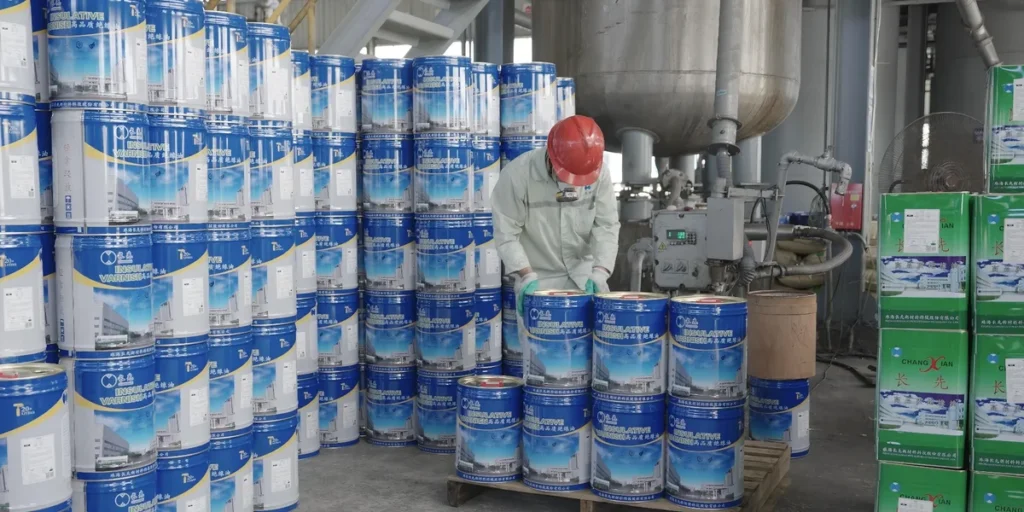
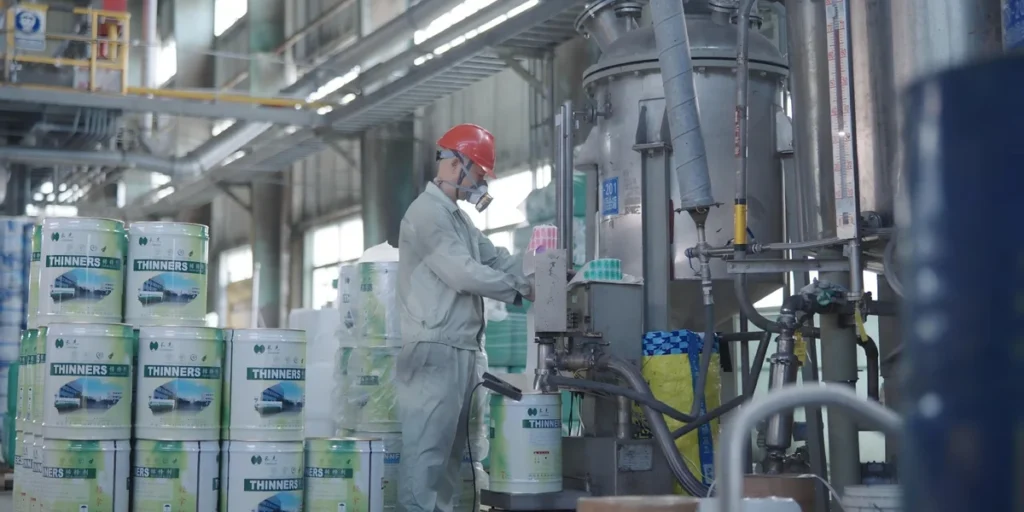
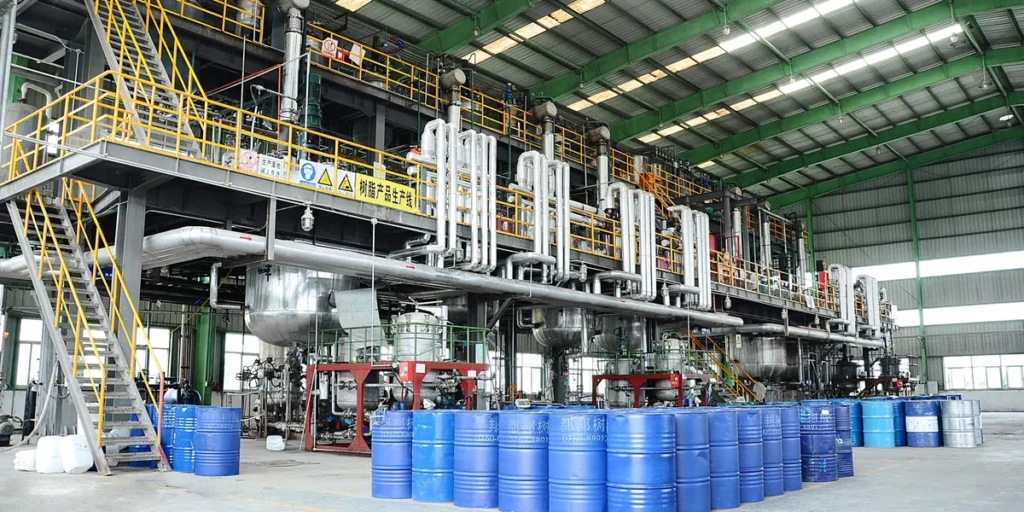
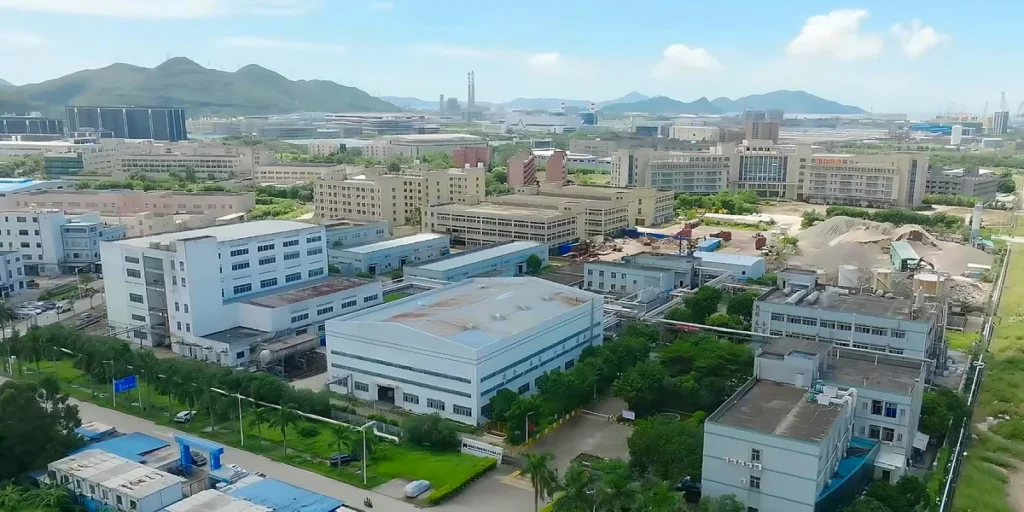
Backed by a 40,000 m² production base in China, in-house resin synthesis, 20,000 tons of annual capacity and a factory-direct model, Changxian New Material gives you stable supply, fast response and a more competitive total sourcing cost. TDS, MSDS, RoHS, REACH, halogen-free and VOC test reports are available, and E962 is additionally covered by a UL certification file.
Use this insulating varnish guide as a starting point, then confirm the final grade against the product TDS and your actual process.
Not Sure Which Grade? Tell Us Your Application
Not sure which grade you need? You don’t have to read the whole guide. Tell us your part type and process — our engineers will pick the right grade and get back to you within 24 hours. Want the details first? Just keep reading.
Insulating Varnish Selection Guide
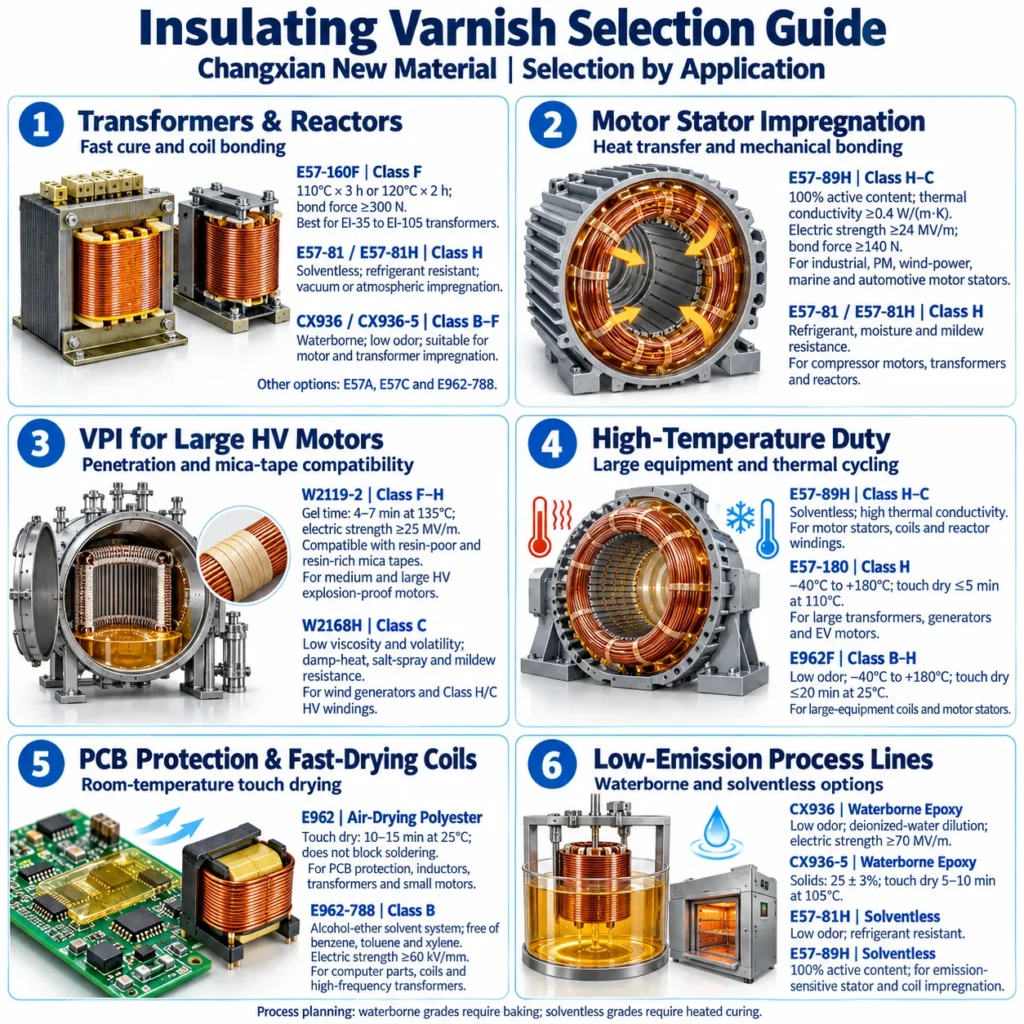
I. Selection by Application
1. Small & Medium Transformers and Reactors: Fast Cure and Bond Strength
When your transformer and reactor line needs shorter bake cycles, stronger coil bonding and lower electromagnetic noise, start with this group of transformer varnish grades. Changxian New Material grades you can evaluate include:
E57-160F Solventless Unsaturated Polyester Insulating Varnish (Class F)
Features: fast cure (110°C×3 h or 120°C×2 h); shear bond strength ≥300 N helps reduce electromagnetic vibration and noise; solventless system with high build.
Best for: impregnation of EI-35 to EI-105 transformers.
E57-81 / E57-81H Solventless Insulating Resin (Class H)
Features: single-component solventless polyester, refrigerant resistant, breakdown strength ≥22 MV/m; works with both vacuum and atmospheric impregnation; 81H is the eco formulation.
Best for: Class B/F/H/C dry-type power transformers and reactors, and EV motors.
CX936 / CX936-5 Modified Waterborne Epoxy Insulating Varnish (Class B-F)
Features: waterborne, non-flammable and low-odor; bond strength ≥70 N; touch dry 5–10 min (105°C).
Best for: motor and transformer impregnation, especially high-frequency transformers.
For baking processes on small and medium transformers, E57A and E57C (alkyd-amino, Class B–F) are also options; for high-frequency transformers, E962-788 (free of benzene, toluene and xylene) is another candidate.
2. Motor Stator Impregnation: High Thermal Conductivity and High Bond Strength
When your motor stator needs lower temperature rise, higher mechanical strength or refrigerant resistance, evaluate this group of motor winding varnish grades first. Changxian New Material grades you can evaluate include:
E57-89H Eco Solventless Epoxy-Polyester Impregnating Varnish (Class H–C)
Features: single-component, 100% active content, zero VOC, flash point >96°C; thermal conductivity ≥0.4 W/(m·K) helps reduce motor temperature rise; electric strength ≥24 MV/m and bond strength ≥140 N (ambient).
Best for: varnish for electric motors — stator impregnation of three-phase asynchronous, PM, wind-power, marine, automotive and water-pump motors.
E57-81 / E57-81H Solventless Insulating Resin (Class H)
Features: refrigerant resistance stated in the TDS; moisture- and mildew-resistant with fast bake curing; breakdown strength ≥22 MV/m.
Best for: refrigerant-resistant motors such as compressors, plus dry-type transformers and reactors.
3. VPI for Medium & Large HV Motors: Storage Stability and Mica Tape Compatibility
When your medium or large HV motors use vacuum pressure impregnation (VPI), you need a dedicated low-volatility, fast-gelling VPI impregnating varnish. Changxian New Material grades you can evaluate include:
W2119-2 Solventless VPI Impregnating Resin (Class F–H)
Features: epoxy-modified unsaturated polyester; gel time 4–7 min (135°C); breakdown strength ≥25 MV/m; acid value ≤8 mgKOH/g; good storage stability; compatible with resin-poor and resin-rich mica tapes.
Best for: global VPI of Class F–H medium and large HV explosion-proof motors.
W2168H Solventless VPI Impregnating Resin (Class C)
Features: epoxy + modified polyester system, low viscosity and low volatility; the cured system resists damp heat, salt spray and mildew; -45°C low-temperature resistance; refrigerant resistant.
Best for: wind turbine generators and Class H/C medium and large HV machines and windings.
4. High-Temperature Duty & Large Equipment: -40°C to 180°C Wide Temperature Range
When your equipment runs hot with frequent thermal cycling, select Class H or above with margin. Changxian New Material grades you can evaluate include:
E57-89H Eco Solventless Epoxy-Polyester Impregnating Varnish (Class H–C)
Features: 100% active content, theoretical zero VOC, flash point >96°C; thermal conductivity ≥0.4 W/(m·K); electric strength ≥24 MV/m.
Best for: motor stator impregnation, small/medium coils and reactor windings.
E57-180 Modified High-Temperature Polyester Insulating Varnish (Class H)
Features: withstands -40°C to 180°C; touch dry ≤5 min at 110°C; accommodates the thermal-expansion difference between metal and insulation.
Best for: large transformers, large generators, EV motors and motor stator coils.
E962F Low-Odor Air-Drying Polyester Insulating Varnish (Class B-H)
Features: low odor; -40°C to 180°C service; air-dries at 25°C (touch dry ≤20 min); halogen-free and benzene-free.
Best for: coils of medium and large equipment, large transformers, large generators, EV motor stators.
5. PCB Protection & Fast-Drying Coils: Air-Drying, Non-Solder-Blocking
When your line has no oven and needs room-temperature touch drying, choose an air-drying electrical varnish. Changxian New Material grades you can evaluate include:
E962 Modified Polyester Air-Drying Insulating Varnish (Class B-H)
Features: touch dry 10–15 min at 25°C; does not block soldering; dielectric strength ≥30 kV/mm; UL certification file coverage.
Best for: PCB protection, inductor coils, transformers, small and medium motors.
E962-788 Modified Acrylic Eco Insulating Varnish (Class B)
Features: alcohol-ether solvent system, free of benzene, toluene and xylene; electric strength ≥60 kV/mm; excellent low-temperature performance.
Best for: computer parts, coils, high-frequency transformers.
6. Environment- & Safety-Sensitive Lines: Waterborne and Zero VOC
When your line has explosion-proof, VOC-limit or export environmental requirements, evaluate waterborne and solventless systems first. Changxian New Material grades you can evaluate include:
CX936 Waterborne Epoxy Insulating Varnish (Class B-F)
Features: non-flammable, non-explosive and low-odor, dilutable with deionized water; dielectric strength ≥70 MV/m and volume resistivity ≥1×10¹² Ω·m; excellent wetting and rust prevention.
Best for: impregnation of motors and transformers; lines with strict safety and environmental requirements.
CX936-5 Modified Waterborne Epoxy Insulating Varnish (Class B-F)
Features: solids 25±3%; bond strength ≥70 N; touch dry 5–10 min, through dry ≤120 min (105°C); waterborne, non-flammable and low-odor.
Best for: motor and transformer impregnation, especially high-frequency transformers.
E57-81H Eco Solventless Insulating Resin (Class H)
Features: eco single-component solventless formulation; no solvent evaporation, low odor, refrigerant resistant.
Best for: dry-type transformers, reactors, EV motors and other environmentally sensitive impregnation processes.
E57-89H Eco Solventless Epoxy-Polyester Impregnating Varnish (Class H–C)
Features: 100% active content, zero VOC, flash point >96°C; thermal conductivity ≥0.4 W/(m·K); electric strength ≥24 MV/m.
Best for: motor stator impregnation, small/medium coils and reactor windings — for lines with strict emission requirements.
Waterborne varnishes need baking conditions; solventless varnishes need heated curing equipment — please confirm your line conditions before adoption.
II. Selection by Chemistry
1. Waterborne Insulating Varnish: Safety, Low Odor and Environmental Compliance
When your line has strict safety and environmental requirements (non-flammable, low VOC) and baking conditions are available, choose a waterborne system. Changxian New Material grades you can evaluate include:
CX936 Waterborne Epoxy Insulating Varnish
Features: viscosity 11–15 s (No. 4 cup, 25°C); solids 20±2%; dielectric strength ≥70 MV/m and volume resistivity ≥1×10¹² Ω·m; dilutable with deionized water.
Best for: impregnation insulation of motors and transformers.
CX936-5 Modified Waterborne Epoxy Insulating Varnish
Features: solids 25±3%; bond strength ≥70 N; touch dry 5–10 min, through dry ≤120 min (105°C).
Best for: motor and transformer impregnation, especially high-frequency transformers.
Waterborne varnishes have relatively low solids and need baking conditions; during selection, confirm that the thermal class fits your actual duty.
2. Solvent-Based Insulating Varnish: Mature Process, Air-Drying and Baking Grades
When you need a mature, stable process, a dense film and flexible application (air-drying or baking), choose a solvent-based system. Changxian New Material grades you can evaluate include:
E962 Modified Polyester Air-Drying Insulating Varnish (Class B)
Features: touch dry 10–15 min at 25°C; does not block soldering; dielectric strength ≥30 kV/mm; dielectric constant 2.7 (1 MHz); UL certification file coverage.
Best for: PCB protection, inductor coils, transformers, small and medium motors.
E962F Low-Odor Air-Drying Polyester Insulating Varnish
Features: low odor; halogen-free and benzene-free; -40°C to 180°C service.
Best for: coils of medium and large equipment, large transformers, large generators, EV motor stators.
E962-788 Modified Acrylic Eco Insulating Varnish (Class B)
Features: alcohol-ether solvent system, free of benzene, toluene and xylene; electric strength ≥60 kV/mm.
Best for: computer parts, coils, high-frequency transformers.
E57A Alkyd-Amino Baking Insulating Varnish (Class B–F)
Features: electric strength ≥60 kV/mm; volume resistivity ≥1×10¹⁴ Ω·m; fast internal drying.
Best for: baking insulation of small and medium transformers and motors.
E57C Alkyd-Amino Baking Insulating Varnish (Class B–F)
Features: electric strength ≥70 kV/mm; low bubble formation during baking.
Best for: transformer impregnation; network transformer potting.
E57-180 Modified High-Temperature Polyester Insulating Varnish (Class H)
Features: -40°C to 180°C service; touch dry ≤5 min at 110°C.
Best for: large transformers, large generators, EV motors and motor stator coils.
Solvent-based varnishes contain VOC and require ventilation, fire protection and solvent management; store away from ignition sources.
3. Solventless Insulating Varnish: Zero Emission, High Fill and VPI Compatibility
When you need no solvent emission, high build and deep fill (dip or VPI processes), choose a solventless system. Changxian New Material grades you can evaluate include:
E57-89H Eco Solventless Epoxy-Polyester Impregnating Varnish (Class H–C)
Features: 100% active content, zero VOC; thermal conductivity ≥0.4 W/(m·K); electric strength ≥24 MV/m.
Best for: motor stator impregnation, small/medium coils and reactor windings.
E57-160F Solventless Unsaturated Polyester Insulating Varnish (Class F)
Features: fast cure (110°C×3 h or 120°C×2 h); shear bond strength ≥300 N.
Best for: impregnation of EI-35 to EI-105 transformers.
E57-81 / E57-81H Solventless Insulating Resin (Class H)
Features: single-component unsaturated polyester, refrigerant resistant; breakdown strength ≥22 MV/m; gel time 6±3 min (140°C).
Best for: dry-type transformers, reactors and EV motors; vacuum and atmospheric impregnation both applicable.
W2119-2 Solventless VPI Impregnating Resin (Class F–H)
Features: good storage stability; compatible with resin-poor and resin-rich mica tapes; breakdown strength ≥25 MV/m.
Best for: global VPI of medium and large HV explosion-proof motors.
W2168H Solventless VPI Impregnating Resin (Class C)
Features: -45°C low-temperature resistance; refrigerant, salt-spray and mildew resistant; breakdown strength ≥23 MV/m.
Best for: wind turbine generators and Class H/C medium and large HV motors.
Solventless varnishes need heated curing equipment; store protected from light below 40°C.

III. Selection by Thermal Class
1. Class B (130°C): Standard Duty and Fast-Drying Needs
When your parts run at moderate temperatures and you prioritize process efficiency and cost, Class B is sufficient. Changxian New Material grades you can evaluate include:
E962 Modified Polyester Air-Drying Insulating Varnish (Class B)
Features: air-drying and non-solder-blocking; touch dry 10–15 min at 25°C; UL certification file coverage.
Best for: PCB protection, inductor coils, small and medium motors.
E962-788 Modified Acrylic Eco Insulating Varnish (Class B)
Features: benzene-free eco formulation; excellent low-temperature performance.
Best for: computer parts, coils, high-frequency transformers.
2. Class F (155°C): Medium Temperature-Rise Duty
When your transformers and industrial motors see medium temperature rise, select Class F with margin. Changxian New Material grades you can evaluate include:
E57-160F Solventless Unsaturated Polyester Insulating Varnish (Class F)
Features: solventless and fast-curing; shear bond strength ≥300 N.
Best for: impregnation of EI-35 to EI-105 transformers.
E57A / E57C Alkyd-Amino Baking Insulating Varnish (Class B–F)
Features: electric strength ≥60/70 kV/mm; E57C forms few bubbles during baking.
Best for: baking insulation of small and medium transformers and motors, and network transformer potting.
3. Class H (180°C): High-Temperature and High-Power Duty
When your large transformers, generators and EV motors run hot for long periods, select Class H. Changxian New Material grades you can evaluate include:
E57-89H Eco Solventless Epoxy-Polyester Impregnating Varnish (Class H–C)
Features: theoretical zero VOC; thermal conductivity ≥0.4 W/(m·K).
Best for: motor stator impregnation.
E57-81 / E57-81H Solventless Insulating Resin (Class H)
Features: solventless and refrigerant resistant; vacuum and atmospheric impregnation both applicable.
Best for: dry-type transformers, reactors, EV motors.
E57-180 Modified High-Temperature Polyester Insulating Varnish (Class H)
Features: -40°C to 180°C service.
Best for: coils of medium and large high-temperature equipment.
W2119-2 Solventless VPI Impregnating Resin (Class F–H)
Features: compatible with resin-poor and resin-rich mica tapes; storage stable.
Best for: medium and large HV explosion-proof motors.
4. Class C (above 180°C): Wind Power and Special High-Temperature Duty
When your wind turbine generators or special high-temperature motors need Class C insulation, Changxian New Material grades you can evaluate include:
W2168H Solventless VPI Impregnating Resin (Class C)
Features: -45°C low-temperature resistance; refrigerant and salt-spray resistant.
Best for: wind turbine generators and Class H/C medium and large HV motors.
E57-89H Eco Solventless Epoxy-Polyester Impregnating Varnish (Class H–C)
Features: theoretical zero VOC; thermal conductivity ≥0.4 W/(m·K).
Best for: motor stator impregnation.
Select the thermal class with margin above your actual maximum operating temperature; if unsure, send your temperature-rise data to our engineers for confirmation.
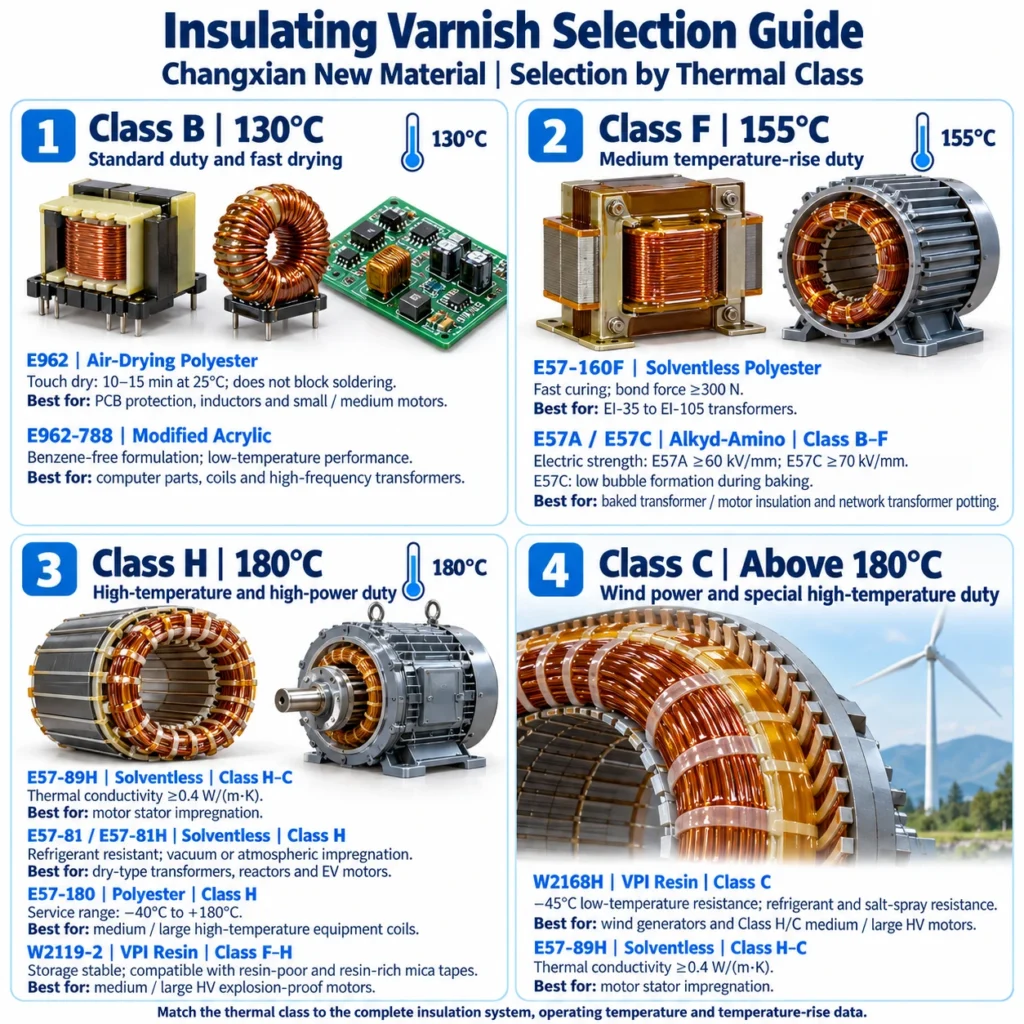
Changxian New Material Insulating Varnish: Parameters & Best-Fit Applications
| Grade | System | Thermal Class | Key Data (TDS) | Cure Schedule (TDS) | Best-Fit Applications |
| CX936 | Waterborne epoxy insulating varnish | Class B–F (130–155°C) | Viscosity 11–15 s (No. 4 cup, 25°C); solids 20±2%; dielectric strength ≥70 MV/m; volume resistivity ≥1×10¹² Ω·m | 90–95°C×3–4 h or 110°C×2–3 h; dilutable with deionized water | Impregnation of motors and transformers; lines with safety and environmental requirements |
| CX936-5 | Modified waterborne epoxy insulating varnish | Class B–F (130–155°C) | Viscosity 11–15 s (No. 4 cup, 25°C); solids 25±3%; dielectric strength ≥60 MV/m; bond strength ≥70 N | Touch dry 5–10 min, through dry ≤120 min (105°C) | Motor and transformer impregnation; especially high-frequency transformers |
| E57-160F | Solventless unsaturated polyester insulating varnish | Class F (155°C) | Viscosity 18–22 s (No. 4 cup, 25°C); breakdown strength 20.5 kV/mm; shear bond strength ≥300 N | 110°C×3 h or 120°C×2 h; drying ≤20 min at 100–120°C | EI-35 to EI-105 transformer impregnation |
| E57-180 | Modified high-temperature polyester insulating varnish (solvent-based) | Class H (180°C) | Viscosity 20±5 s (No. 4 cup, 25°C); non-volatiles 46±3%; -40°C to 180°C service | Touch dry ≤5 min at 110°C, through dry ≤4 h | Large transformers, large generators, EV motors and motor stator coils |
| E57-81 | Solventless unsaturated polyester insulating resin (single-component) | Class H (180°C) | Viscosity 45±15 s (No. 4 cup, 23°C); gel time 6±3 min (140°C); breakdown strength ≥22 MV/m | 140±5°C×6 h (breakdown test condition) | Class B/F/H/C dry-type power transformers and reactors; EV motors; refrigerant-resistant motors; vacuum and atmospheric impregnation |
| E57-81H | Eco solventless unsaturated polyester insulating resin (single-component) | Class H (180°C) | Viscosity 45±15 s (No. 4 cup, 23°C); gel time 6±3 min (140°C); breakdown strength ≥22 MV/m | 140±5°C×6 h (breakdown test condition) | Same as E57-81, eco formulation; dry-type transformers, reactors, EV motors |
| E57-89H | Eco solventless epoxy-polyester impregnating varnish (single-component) | Class H–C (≥180°C) | Viscosity 40–80 s (No. 4 cup, 25°C); 100% active content, zero VOC, flash point >96°C; electric strength ≥24 MV/m; thermal conductivity ≥0.4 W/(m·K); bond strength ≥140 N (ambient) | 135–150°C×≥2 h; gel time 5–15 min (120°C) | Stator impregnation of three-phase asynchronous, PM, wind-power, marine and automotive motors; water-pump motors, small/medium coils and reactor windings |
| E57A | Alkyd-amino baking insulating varnish (solvent-based) | Class B–F (130–155°C) | Viscosity 40–60 s (No. 4 cup, 25°C); non-volatiles 45–55%; electric strength ≥60 kV/mm; volume resistivity ≥1×10¹⁴ Ω·m | 110°C×3–5 h or 120°C×2–4 h | Baking insulation for small/medium transformers and motors |
| E57C | Alkyd-amino baking insulating varnish (solvent-based) | Class B–F (130–155°C) | Viscosity 60–90 s (No. 4 cup, 25°C); non-volatiles 50±2%; electric strength ≥70 kV/mm; low bubble formation during baking | Touch dry ≤30 min at 120°C, through dry ≤120 min | Transformer impregnation; network transformer potting |
| E962 | Modified polyester air-drying insulating varnish (solvent-based) | Class B (130°C) | Viscosity 40–60 s (No. 4 cup, 25°C); non-volatiles 40±2%; dielectric strength ≥30 kV/mm; dielectric constant 2.7 (1 MHz); does not block soldering | Air-drying: touch dry 10–15 min at 25°C; touch dry 5–10 min at 80°C, through dry 75 min | PCB protection, inductor coils, transformers, small/medium motors; UL file coverage |
| E962F | Low-odor air-drying polyester insulating varnish (solvent-based) | Class B/F/H (130–180°C) | Viscosity 16±5 s (No. 4 cup, 25°C); non-volatiles 40±3%; -40°C to 180°C service; halogen-free, benzene-free | Touch dry ≤5 min at 110°C, through dry ≤4 h; touch dry ≤20 min at 25°C | Coils of medium/large equipment, large transformers, large generators, EV motor stators |
| E962-788 | Modified acrylic eco insulating varnish (alcohol-ether solvent system) | Class B (130°C) | Viscosity 52±3 s (No. 4 cup, 25°C); non-volatiles 37±3%; electric strength ≥60 kV/mm; free of benzene, toluene and xylene | 90°C×3–5 h or 100°C×2–4 h | Computer parts, coils, high-frequency transformers |
| W2119-2 | Epoxy-modified unsaturated polyester solventless VPI impregnating resin (single-component) | Class F–H (155–180°C) | Viscosity 45±15 s (No. 4 cup, 23°C); gel time 4–7 min (135°C); breakdown strength ≥25 MV/m; acid value ≤8 mgKOH/g | Casting cured 165±5°C×4 h (breakdown test condition) | Global VPI of Class F/H medium/large HV explosion-proof motors; compatible with resin-poor and resin-rich mica tapes |
| W2168H | Epoxy + modified polyester solventless VPI impregnating resin (single-component) | Class C (>180°C) | Viscosity 50–150 s (No. 4 cup, 25°C); gel time 3–12 min (135°C); breakdown strength ≥23 MV/m; -45°C low-temperature resistance; refrigerant, salt-spray resistant, low water absorption | Casting cured 140±5°C×10 h (breakdown test condition) | VPI insulation of wind turbine generators; Class H/C medium/large HV machines and windings; special high-temperature motors |
Insulating Varnish Comparison Considerations
Choosing an insulating varnish is not about ranking chemistries from best to worst. It is about finding the best fit for your thermal class, process conditions, environmental requirements and production tempo. Before you decide, confirm a few things: the maximum long-term operating temperature of your parts (this determines whether you need Class B, F, H or C); whether your line uses atmospheric dipping, vacuum impregnation or VPI, and whether baking is available; whether your target market imposes VOC emission or export environmental compliance requirements; and how much storage management and batch-to-batch stability you can accommodate. For example, a repair shop or small-batch line without an oven may find an air-drying varnish more economical, while a high-volume motor line will benefit more from the fill and cycle-time advantages of a solventless system.
1. Waterborne insulating varnish suits lines with strict requirements on safety, odor and environmental compliance. It is non-flammable, non-explosive, low-odor and low-VOC, and can be diluted with deionized water — significantly reducing explosion-proofing and solvent-handling pressure in your workshop. The trade-offs are relatively low solids, mandatory baking, and the fact that incomplete moisture removal directly affects insulation resistance — your line must match the baking conditions and cycle time. Changxian New Material grades you can evaluate: CX936, CX936-5.
2. Solvent-based insulating varnish is the most mature system: dense film, strong electrical and mechanical performance, a full range of air-drying and baking grades, and flexible application for most standard duties and varied line conditions. The trade-offs are VOC content, the need for ventilation, fire protection and solvent management, and storage away from ignition sources; if you export to markets with environmental requirements or run an odor-sensitive workshop, confirm the compliance boundaries first. Changxian New Material grades you can evaluate: E57A, E57C, E57-180, E962, E962F, E962-788.
3. Solventless insulating varnish suits dip or vacuum impregnation lines pursuing fill, build and low emissions. There is no solvent evaporation and the odor is low; E57-89H has 100% active content and zero VOC. The trade-offs: heated curing equipment is required; storage must be light-protected below 40°C; and because viscosity drops sharply during heat-up, you should select a grade whose gel time matches your process to control drainage loss during baking. Changxian New Material grades you can evaluate: E57-160F, E57-81, E57-81H, E57-89H.
4. Dedicated solventless VPI resins target the most reliability-critical applications — medium and large HV motors and wind turbine generators — achieving deep winding fill through vacuum pressure impregnation. The prerequisites are VPI equipment and process validation capability at your plant: section a sample coil from the first run to confirm penetration depth, and make sure the vacuum level, pressure-hold time and resin gel time are matched. Changxian New Material grades you can evaluate: W2119-2, W2168H.
Therefore, do not base your insulating varnish selection on a single parameter. Evaluate thermal class, impregnation process, curing conditions, environmental requirements and total cost together. Changxian New Material can help you select a suitable system according to your part type, production line conditions and target market, and provide samples, TDS, MSDS, RoHS and REACH documents for your validation.
How Is Insulating Varnish Used?
Insulating varnish is used to help your motors, transformers, coils and PCBs resist common environmental and operational stresses — moisture, dust, mold, chemical vapors, vibration and thermal cycling — thereby extending the insulation life of your products. The cured film provides electrical insulation, mechanical bonding and heat-transfer support: it bonds the winding into a solid mass, reduces electromagnetic vibration and noise, fills the voids between turns and insulation layers to improve heat dissipation, and lowers the risk of leakage, short circuits and breakdown.
Changxian New Material provides insulating varnish in four systems — waterborne, solvent-based, solventless and air-drying — for motors, transformers and coils, matched to atmospheric dipping, vacuum impregnation, vacuum pressure impregnation (VPI), trickle impregnation and brushing processes. Whatever your priority — thermal class, refrigerant resistance, low odor, fast curing or total cost — you can complete your evaluation with samples, TDS, MSDS, RoHS and REACH documents before production validation.
What Is Insulating Varnish?
Insulating varnish is a functional coating applied to motor windings, transformers, coils and metal parts by dipping, trickling or brushing; once cured, it forms a continuous insulating film that improves the electrical insulation and long-term reliability of your product. An insulating varnish is not simply an “insulating glue,” and the film alone does not equal the insulation rating of the whole machine — the final result depends on the material system, surface cleanliness of your parts, impregnation completeness, film thickness, curing completeness, and your overall insulation system design (the match with companion materials such as magnet wire, slot insulation and sleeving).
By chemistry, insulating varnish falls into waterborne, solvent-based, solventless and air-drying systems; by thermal class it covers Class B (130°C), Class F (155°C), Class H (180°C) and Class C (above 180°C). Selection should always consider your part type, thermal class, impregnation process and baking conditions together.
Insulating Varnish Types Compared
| System | Strengths | Limitations & Checkpoints | Changxian Grades |
| Waterborne insulating varnish | Low odor, low VOC, non-flammable and non-explosive; dilutable with deionized water; safe and eco-friendly. | Relatively low solids; requires baking; confirm thermal class fits your duty. | CX936, CX936-5 |
| Solvent-based insulating varnish | Mature process, dense film, strong electrical and mechanical performance; air-drying and baking grades available. | Contains VOC; requires ventilation, fire protection and solvent management; store away from ignition sources. | E57A, E57C, E57-180, E962, E962F, E962-788 |
| Solventless insulating varnish | No solvent evaporation, high fill and build, suits dip and VPI processes; E57-89H has zero VOC. | Requires heated curing equipment; store protected from light below 40°C. | E57-160F, E57-81, E57-81H, E57-89H, W2119-2, W2168H |
| Air-drying insulating varnish | Fast touch dry at room temperature, no oven required; flexible for repair and small batches. | Long full-cure time and relatively low thermal class; large-volume lines should evaluate cycle time. | E962, E962F |
The four systems above help you and your engineering team understand the selection logic. Beyond them, the industry also offers UV-curing insulating varnish (cures in seconds, requires light transmission and UV equipment) and polyimide specialty varnishes (>220°C, high cost). If you have such requirements, our engineers can evaluate feasibility.
Common Insulating Varnish Problems and Solutions
I. Impregnation & Curing
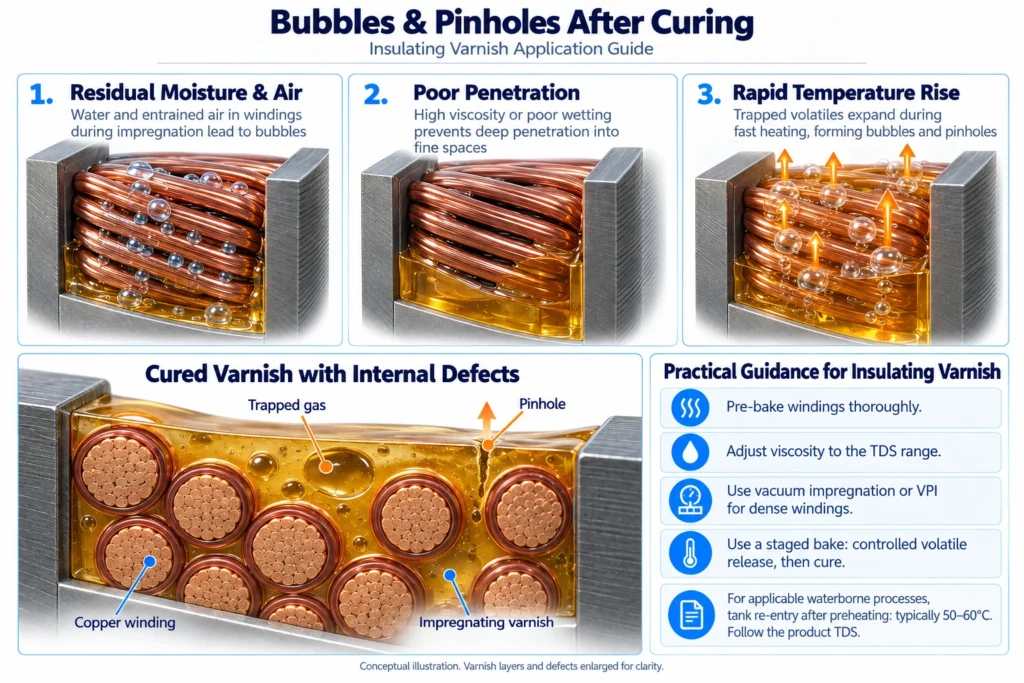
1. Bubbles and pinholes in the cured film
Symptom:
bubbles or pinholes appear on or inside the film after baking; severe cases compromise insulation integrity.
Likely causes:
insufficient pre-baking, so moisture and air remain inside the winding; varnish viscosity too high for proper penetration; deep capillary air cannot escape under atmospheric dipping; ramp-up too fast, so solvent or moisture flashes off and breaks the film.
Fix:
pre-bake parts thoroughly before dipping (waterborne systems typically re-enter the tank at 50–60°C after preheating); adjust viscosity to the TDS range; for dense windings use vacuum impregnation or VPI so air is evacuated before the varnish enters; bake with a step-ramp — hold low temperature for slow solvent release, then raise to the cure temperature.
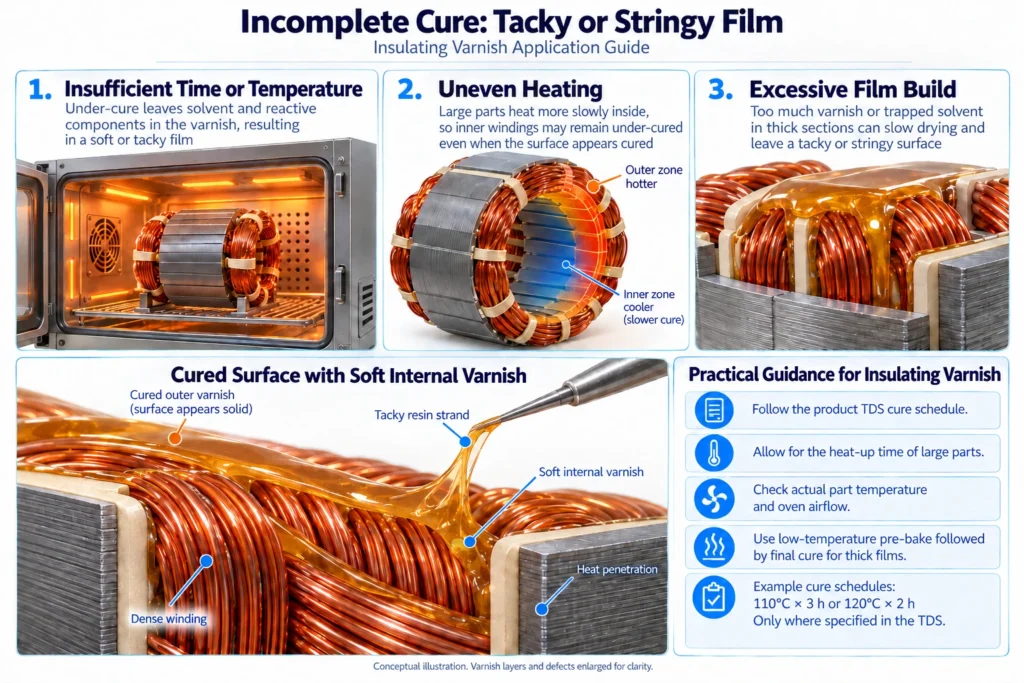
2. Incomplete cure — tacky or stringy film
Symptom:
the core surface feels tacky when hot after baking, or the varnish between coils strings and bonds weakly.
Likely causes:
bake temperature or time below the TDS schedule, so crosslinking is incomplete; large parts and uneven oven temperature mean the core never reaches cure temperature; heavy film build dries unevenly inside and out.
Fix:
follow the cure schedule in the TDS (e.g. 110°C×3 h or 120°C×2 h type schedules) and extend time for large parts; verify actual oven temperature and airflow uniformity; for thick films use a “low-temperature pre-bake + high-temperature cure” profile to avoid a skinned-over surface with a wet core.
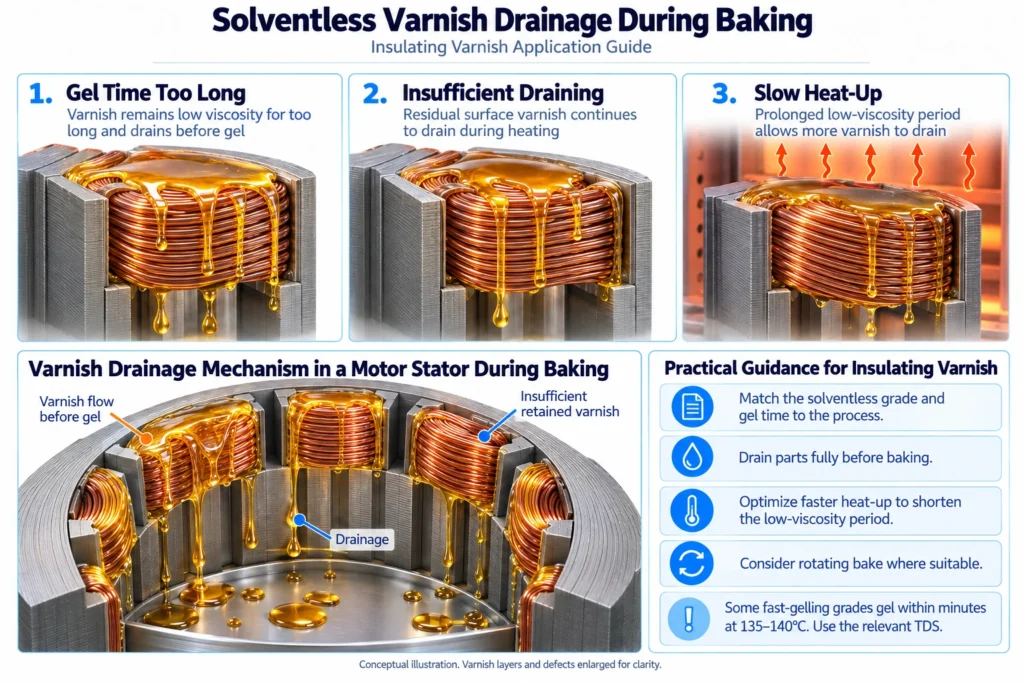
3. Heavy drainage of solventless varnish during baking
Symptom:
after dipping, the varnish drips out of the winding in the oven and build is clearly insufficient. Low-viscosity solventless systems thin sharply as temperature rises — a known process challenge for this chemistry.
Likely causes:
gel time too long for the process, so viscosity collapses during heat-up; insufficient draining before the oven; ramp-up too slow, leaving the varnish in its low-viscosity window too long.
Fix:
choose a solventless grade whose gel time matches your process (gel time data is in the TDS — fast-gelling systems that gel within minutes at 135–140°C reduce drainage noticeably); drain parts fully before baking; raise temperature faster to shorten the low-viscosity window; consider rotating bake where applicable.
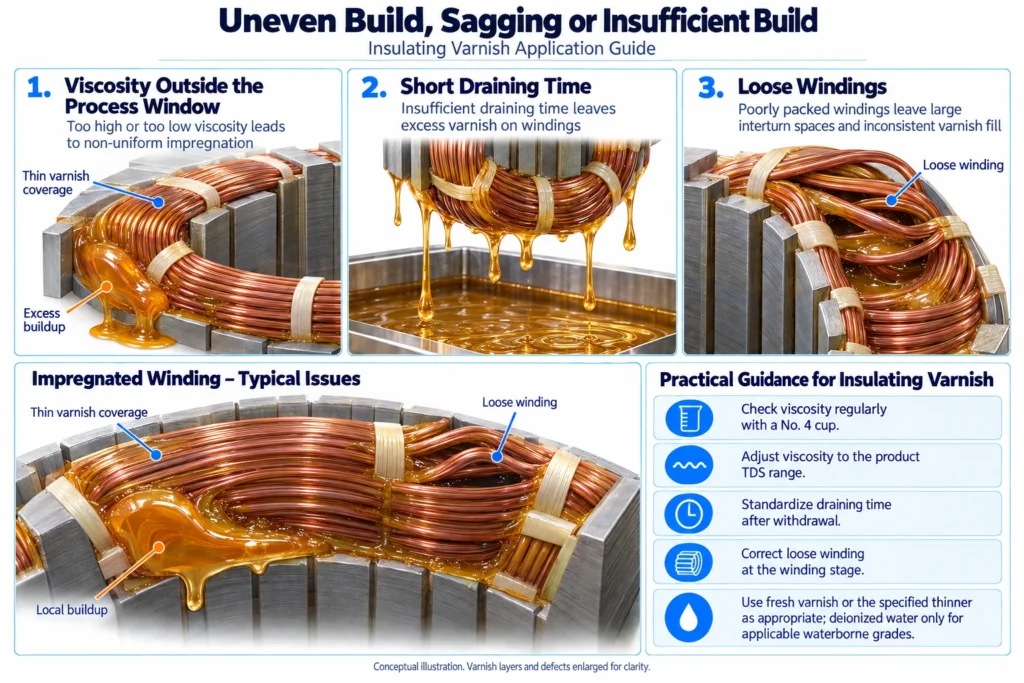
4. Uneven build, local sagging or insufficient build
Symptom:
film thickness varies across the winding, with local sagging or an overall thin, loosely bonded coil.
Likely causes:
viscosity outside the process window — too high levels poorly and piles up, too low cannot hold on the winding; draining time too short after withdrawal; loosely wound coils.
Fix:
check viscosity regularly with a No. 4 cup and adjust to the TDS range; add fresh varnish when viscosity runs low, or adjust with the matching thinner (deionized water for waterborne grades); standardize draining time; loose windings must be fixed at the winding step.
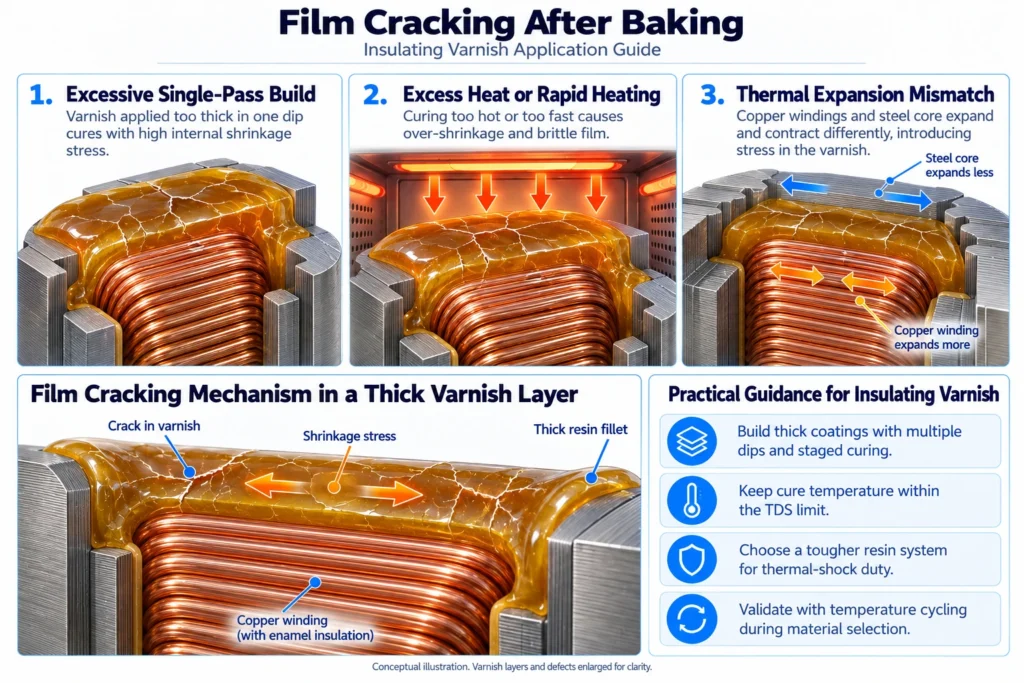
5. Film cracking after baking
Symptom:
cracks in the cured film, usually on thick coats, edges and corners, or after thermal cycling.
Likely causes:
too much build in one pass, so surface and core shrink unevenly; cure temperature too high or ramp too fast; film toughness insufficient for the thermal expansion mismatch of the part.
Fix:
build thick coats in multiple dips with staged curing; keep cure temperature within the TDS upper limit; for thermal-shock duty choose a tougher resin system and validate with temperature cycling during selection.
II. Varnish Handling & Storage
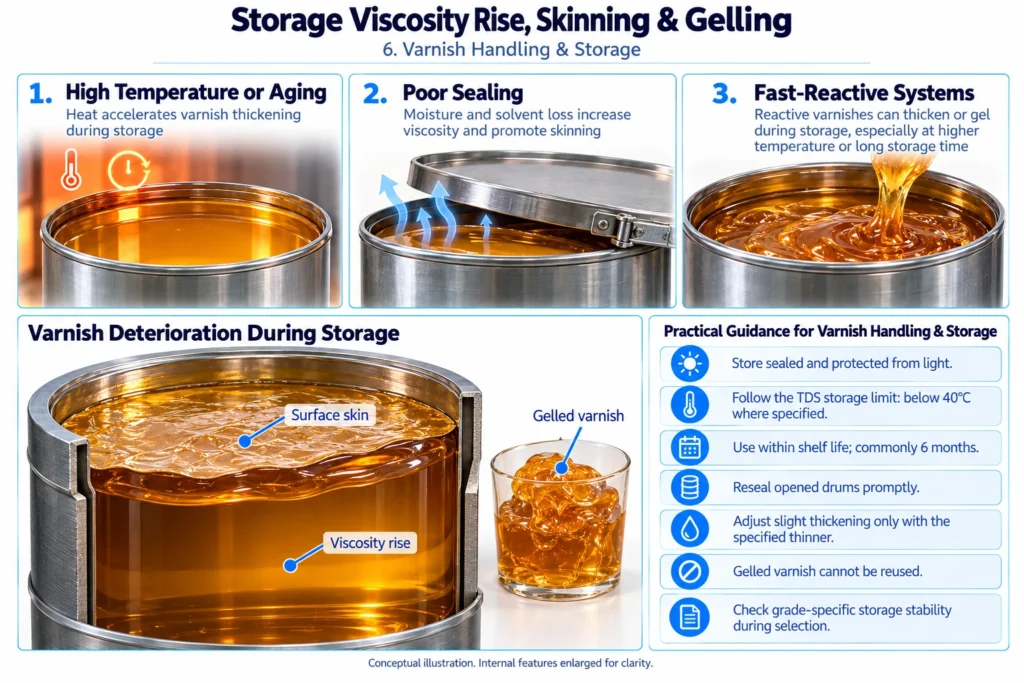
6. Viscosity rise, skinning or gelling in storage
Symptom:
viscosity climbs during storage, a skin forms on the drum surface, and in severe cases the whole drum gels.
Likely causes:
storage temperature too high or shelf life exceeded, so reactive components slowly polymerize; poor sealing, solvent loss or air contact; fast-curing systems are inherently shorter-lived.
Fix:
store sealed, protected from light, below 40°C per TDS, and use within shelf life (commonly 6 months); reseal opened drums promptly; small viscosity increases can be adjusted with the matching thinner per TDS — gelled varnish cannot be reused. At selection, check storage-stability data (some solventless epoxy systems specify storage thickening below 20%).
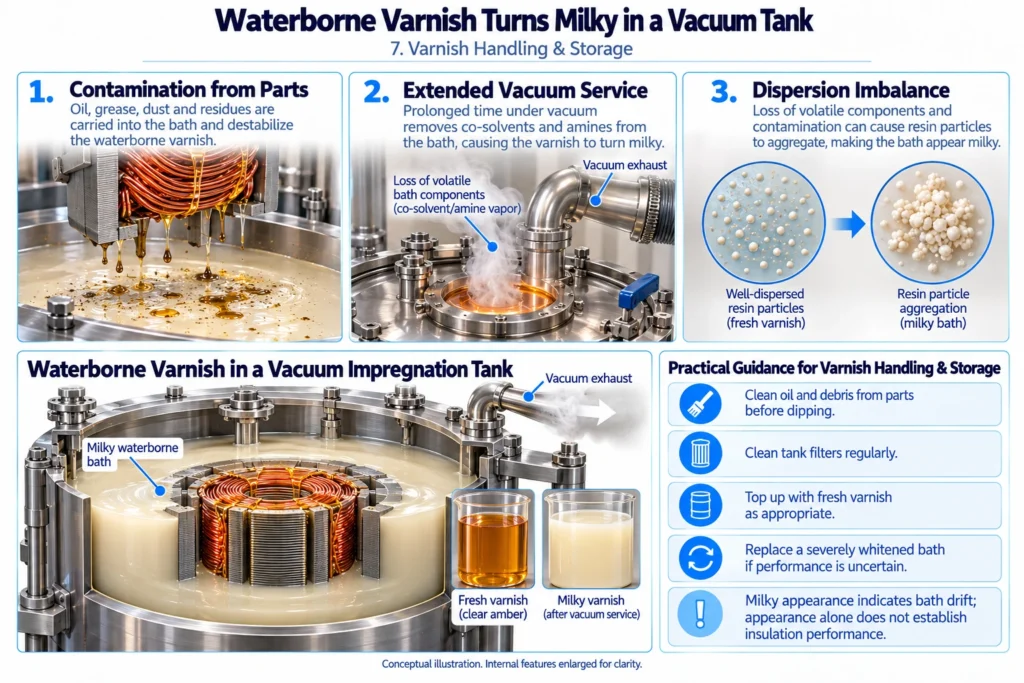
7. Waterborne varnish turns milky in a long-running vacuum tank
Symptom:
in vacuum tanks with low monthly consumption, the varnish gradually turns milky and loses transparency after long vacuum service.
Likely causes:
dust, rust, stamping oil and anti-rust oil carried in by parts contaminate the tank; in waterborne systems, co-solvents and amines volatilize faster under sustained negative pressure, breaking the dispersion balance — resin particles grow and the liquid looks milky. This is a known behavior of waterborne insulating varnish and does not directly reduce insulation performance, but it shows the bath has drifted.
Fix:
clean oil and debris off parts before dipping; clean the tank filter regularly; top up with fresh varnish to restore bath condition; replace the bath if whitening is severe and performance is in doubt.
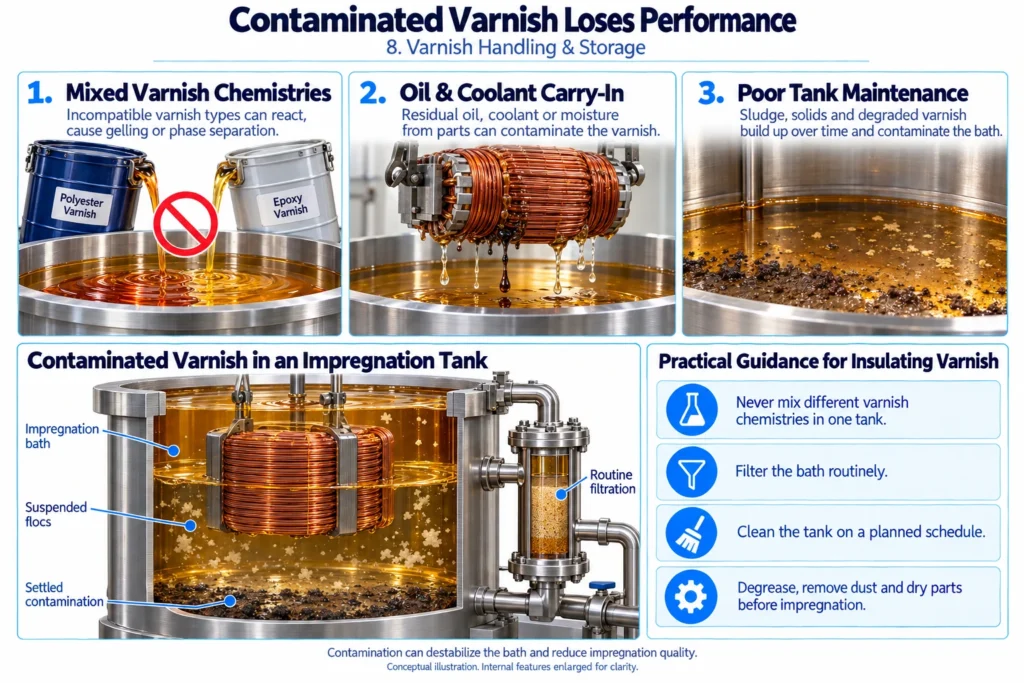
8. Contaminated varnish loses performance
Symptom:
sediment or flocs appear in the tank, or overall impregnation quality declines over time.
Likely causes:
mixing different varnish systems (acids, alkalis or oily substances destabilize waterborne systems and cause precipitation); oil and coolant carried in continuously; the tank has not been cleaned for a long time.
Fix:
never mix chemistries in one tank; set up routine bath filtration and tank cleaning; degrease, dedust and dry parts before impregnation.
III. Electrical Performance & Field Failures
9. Low insulation resistance or failed hipot after baking
Symptom:
finished parts fail insulation resistance or withstand-voltage tests — the most common complaint at end-of-line.
Likely causes:
film not fully dried (waterborne systems are especially sensitive — residual moisture directly drags down insulation resistance and can even cause leakage failures); enamel wire damaged during winding or assembly; moisture not fully driven out of the winding; film defects such as pinholes or cracks.
Fix:
test insulation resistance and hipot before impregnation to rule out incoming defects; keep baking impregnated parts until values pass — extend time or raise temperature moderately and keep oven exhaust clear; always dry waterborne systems completely before electrical testing.

10. Insulation resistance drops after humidity exposure
Symptom:
insulation resistance falls sharply after damp-heat testing or storage in humid conditions.
Likely causes:
incomplete impregnation — internal voids unfilled and no continuous outer film, leaving channels for moisture; companion insulation (slot liners, leads, sleeving) with poor moisture resistance.
Fix:
improve the impregnation process — upgrade to vacuum impregnation or VPI where needed — so internal voids are filled and the outer film is continuous; review the moisture resistance of the whole insulation system, not just the varnish.

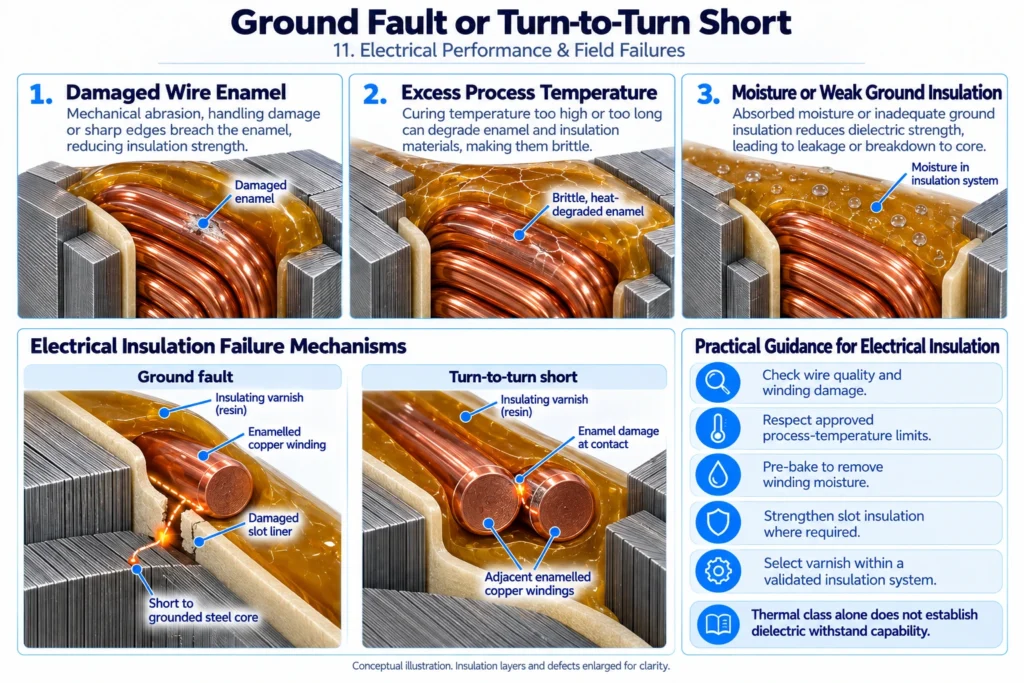
11. Ground fault or turn-to-turn short after treatment
Symptom:
ground breakdown or inter-turn short circuits still occur after insulation treatment.
Likely causes:
enamel wire damaged or with poor adhesion; process temperature high enough to harm the wire enamel; varnish applied before winding moisture was fully removed; ground insulation or varnish insulation level insufficient.
Fix:
check wire quality and winding damage; respect the TDS process-temperature ceiling; pre-bake to remove moisture before impregnation; where needed move to a higher-class varnish or strengthen slot insulation.
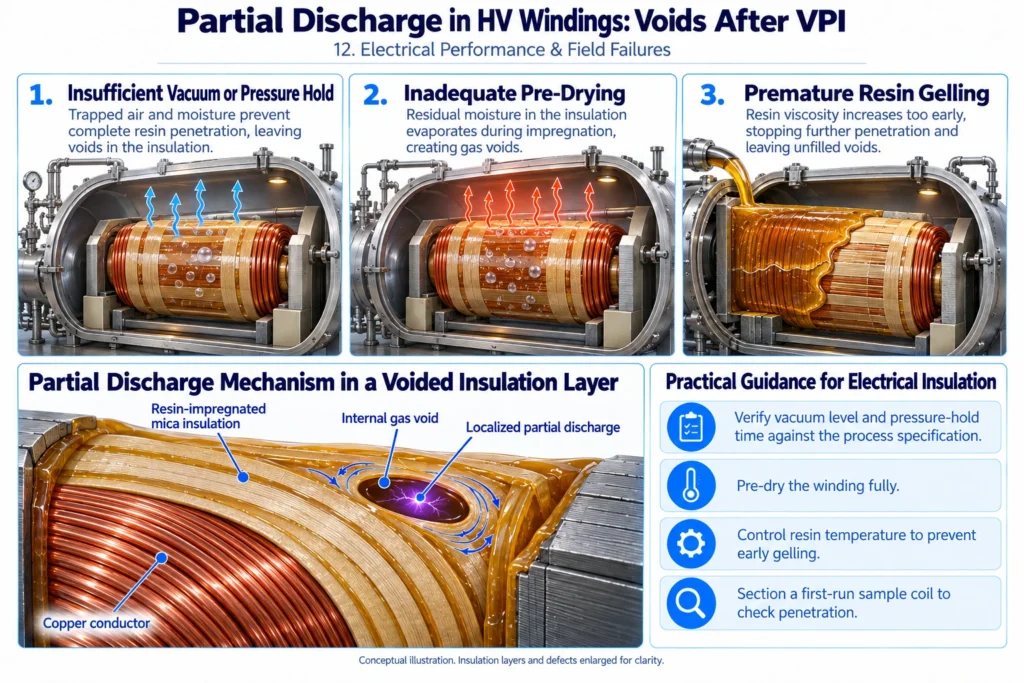
12. Partial discharge in HV windings — voids after VPI
Symptom:
HV motor windings fail partial-discharge limits; sectioning shows internal voids and locally missing resin.
Likely causes:
vacuum level or pressure hold insufficient, so micro-voids stay unfilled; pre-drying inadequate and moisture remains; resin too warm and gelling early, stopping penetration mid-cycle.
Fix:
verify vacuum level and pressure-hold time against the process spec; ensure full pre-drying; control resin temperature to avoid premature gelling; section a sample coil from the first run to verify penetration depth.
IV. Companion Materials & Appearance
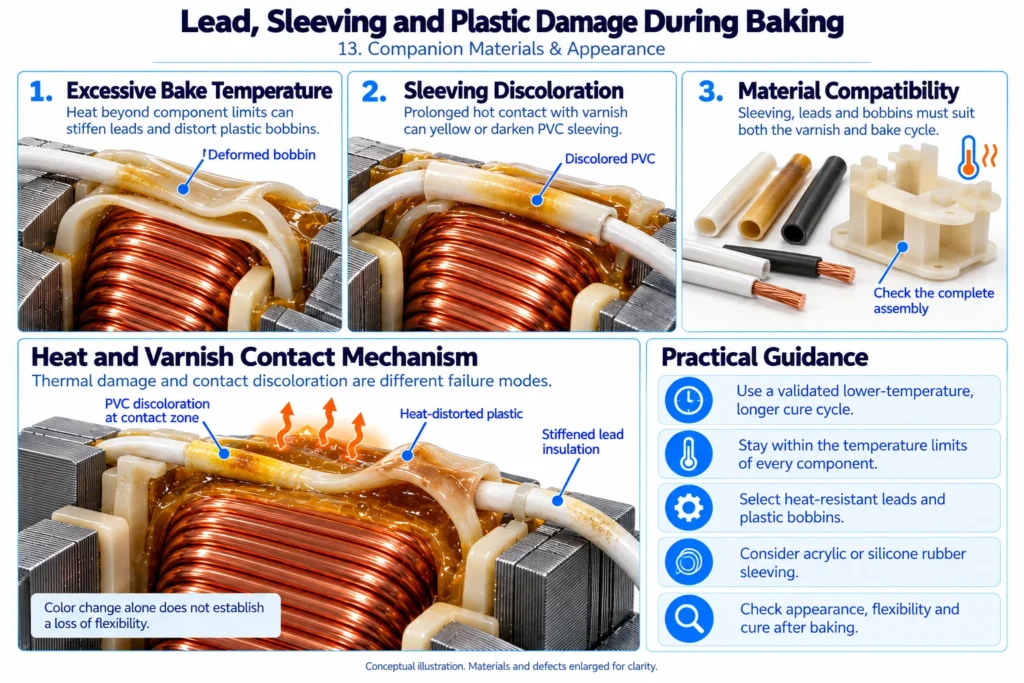
13. Leads harden or discolor, plastic parts deform, sleeving yellows during baking
Symptom:
PVC sleeving yellows or darkens, leads stiffen, plastic bobbins deform after baking.
Likely causes:
bake temperature exceeds the companion materials’ limits; PVC sleeving in long hot contact with the varnish (especially weakly alkaline waterborne systems) discolors — flexibility is usually unaffected, but appearance is not acceptable.
Fix:
lower the bake temperature and extend time accordingly; use high-temperature leads and plastic parts; switch sleeving to acrylic or silicone rubber materials.
14. Poor adhesion, peeling film, or flash rust on cores (waterborne)
Symptom:
film peels or flakes after baking; flash rust appears on bare cores when applying waterborne varnish.
Likely causes:
dust, oil or anti-rust oil left on the surface, so the film cannot anchor; thermal expansion mismatch between varnish and substrate causes delamination after temperature swings; waterborne systems on bare steel in humid conditions are prone to flash rust.
Fix:
clean and dry parts thoroughly before impregnation; match the varnish system to the substrate and verify adhesion at selection; control humidity on waterborne lines, shorten part exposure, and use a system with flash-rust additives where needed.

Insulating Varnish Buying Guide FAQ
Q1: What is an insulating varnish?
An insulating varnish (also called an electrical varnish) is an insulating and protective coating for motors, transformers, coils and PCBs. After impregnation or coating and curing, it forms an insulating film that provides electrical insulation, mechanical fixing, moisture and mildew resistance, and heat dissipation support. Common application methods include atmospheric dipping, vacuum impregnation and vacuum pressure impregnation (VPI).
Q2: What do thermal classes B, F, H and C mean?
The thermal class is the maximum long-term operating temperature allowed for an insulation system: Class B 130°C, Class F 155°C, Class H 180°C and Class C above 180°C. Always select with margin above your actual maximum operating temperature.
Q3: Solventless vs solvent-based insulating varnish — how do I choose?
Solventless varnish contains no volatile solvent: high fill, high build, low odor, and well suited to dip and VPI processes — but it needs heated curing equipment. Solvent-based varnish is a mature process with flexible air-drying grades, but it contains VOC and requires ventilation and solvent management. Lines with strict environmental or safety requirements can also evaluate non-flammable, non-explosive waterborne insulating varnish.
Q4: Can waterborne insulating varnish meet motor requirements?
It is worth evaluating. CX936, for example, lists a dielectric strength of ≥70 MV/m and volume resistivity of ≥1×10¹² Ω·m in its TDS, and is widely used for motor and transformer impregnation. Waterborne varnishes have relatively low solids and need baking, so we recommend an impregnation and curing trial on your real parts before adoption.
Q5: What is VPI? Which grade fits?
VPI (Vacuum Pressure Impregnation) alternates vacuum and pressure to drive resin deep into the winding, and is common for medium and large HV motors. W2119-2 (Class F–H, compatible with resin-poor and resin-rich mica tapes) and W2168H (Class C, especially for wind turbine generators) are Changxian’s dedicated solventless VPI impregnating varnish grades.
Q6: Which grade do you recommend for motor stator impregnation?
As a motor winding varnish for general-purpose and EV motor stators, we recommend E57-89H: single-component solventless, 100% active content, zero VOC, thermal class H–C (≥180°C), thermal conductivity ≥0.4 W/(m·K); its TDS lists three-phase asynchronous, PM, wind-power, marine and automotive motors. If budget or process conditions are limited, evaluate E57-81/81H or the solvent-based series by thermal class.
Q7: Which grade do you recommend for transformer impregnation?
For EI-35 to EI-105 transformers, E57-160F (Class F solventless, fast cure); for dry-type power transformers and reactors, E57-81/81H (Class H, for Class B/F/H/C dry-type units); for baking processes on small and medium transformers, E57A/E57C; for high-frequency transformers, CX936-5 or E962-788.
Q8: Can insulating varnish be diluted?
It depends on the system: waterborne grades (CX936) can be diluted with deionized water; solvent-based and solventless grades should use the matching dedicated thinner (e.g. X-58 for E57-160F) and be adjusted within the TDS viscosity range. We do not recommend non-matching solvents — they can impair curing and electric strength.
Q9: What are the packaging, storage and shelf life?
The common specification across TDS files: 20 kg or 200 kg drums; store sealed in a cool, ventilated place away from sunlight and UV, below 40°C; shelf life 6 months. Avoid long sealed standstill during use — moderate circulation and agitation help extend storage life.
Q10: What compliance documents can you provide?
TDS and MSDS are available for every grade; RoHS, REACH, halogen-free and VOC test reports are available for the main grades; E962 is additionally covered by a UL certification file. For the exact document set of a specific grade, please confirm with our engineers.
Q11: Are samples available? How do I apply?
Yes — samples are available for impregnation, curing and electrical verification. Send us your part type, thermal class requirement, impregnation process (atmospheric / vacuum / VPI) and baking conditions, and our engineers will recommend a grade and arrange samples.
Q12: How can I narrow down the selection quickly?
Four pieces of information are enough: part type (motor / transformer / coil / PCB), thermal class (B/F/H/C), process conditions (atmospheric, vacuum or VPI; oven available or not), and environmental requirements (VOC limits). Send these four to our engineers and you will receive a targeted grade recommendation with TDS data.
Advantages of Changxian New Material Insulating Varnish
· Complete range: waterborne, solvent-based, solventless and air-drying systems — one selection covers most motor, transformer and coil applications.
· Full thermal class coverage: Class B (130°C), Class F (155°C), Class H (180°C) and Class C (>180°C) requirements.
· Solventless eco system: E57-89H with 100% active content, zero VOC and flash point >96°C — non-flammable, non-explosive and low odor.
· Waterborne safety system: the CX936 series is non-flammable, non-explosive, low-odor and low-VOC, dilutable with deionized water — for lines with strict safety and environmental requirements.
· Dedicated VPI resins: W2119-2 (Class F–H) and W2168H (Class C) fit vacuum pressure impregnation, covering medium and large HV motors and wind turbine generators.
Clear electrical data: dielectric strength up to ≥70 MV/m (CX936); several grades list volume resistivity ≥1×10¹⁴ Ω·m — all data from TDS.
· Complete compliance files: TDS, MSDS, RoHS, REACH, halogen-free and VOC test reports; E962 has a UL certification file.
· China factory advantage: a 40,000 m² production base, a mature electronic-chemicals supply chain and export support give you stable, efficient delivery.
· Factory-direct cost advantage: in-house resin synthesis, 20,000 tons of annual capacity and factory-direct supply help you control sourcing and qualification costs without compromising quality.
· Qualification support: sample testing and engineering selection support — we can help confirm impregnation processes, baking curves and compatibility verification plans.
Whether your priority is impregnation quality, thermal class compliance, lower VOC emissions, or a balance of reliability, compliance files and total cost, Changxian New Material can support your evaluation across five dimensions: material system, impregnation process, curing equipment, compliance files and total cost.
Contact us
Not sure which grade fits your parts and line?
Send Changxian New Material your part type (motor / transformer / coil / PCB), thermal class requirement, impregnation process (atmospheric / vacuum / VPI), baking conditions, production tempo and compliance requirements.
Our engineers can help you pick the right varnish for electric motors, transformers or coils — with impregnation parameter confirmation and compatibility verification — and provide samples, TDS, MSDS, RoHS, REACH, halogen-free and VOC documents for your qualification.
Technical Support & OEM Inquiries
Related Products