UV Conformal Coating Guide
UV Conformal Coating Selection Guide: UV/Moisture Dual Cure Conformal Coating for PCB Protection
This UV conformal coating guide explains how to select and validate UV/moisture dual-cure systems for PCBs with component shadowing. Changxian New Material one-part UV/moisture dual cure conformal coating solution is designed for coating protection of thick-film circuit systems, porous substrates and printed circuit boards. The featured product M78-3068UV cures in seconds under UV light in exposed areas, while shadowed areas are post-cured by moisture — especially suitable for PCBs with component shadowing and automated high-throughput lines; 100% non-volatile content, zero VOCs, zero HAPs and low odor.
M78-3068UV is backed by clear reliability data: 172 h salt spray resistance, 10 days at 85°C/85%RH, 100 thermal shock cycles from -45°C to 135°C, dielectric strength of 75 kV/mm, volume resistivity of 2.6×10¹⁶ Ω·cm and UL 94 V-0 flame rating. With our 40,000 m² production base in China, in-house resin synthesis capability, 20,000-ton annual capacity and factory-direct supply model, Changxian New Material provides you with stable delivery, fast response and a more competitive total procurement cost.
Use this UV conformal coating guide to shortlist a system, then confirm curing, shadow-area coverage and reliability against the product TDS and your actual process.
Not Sure If UV Fits Your Line? Ask Us First
Not sure if UV cure fits your line? You don’t have to read the whole guide. Tell us your board and process — our engineers will confirm and get back to you within 24 hours. Want the details first? Just keep reading.
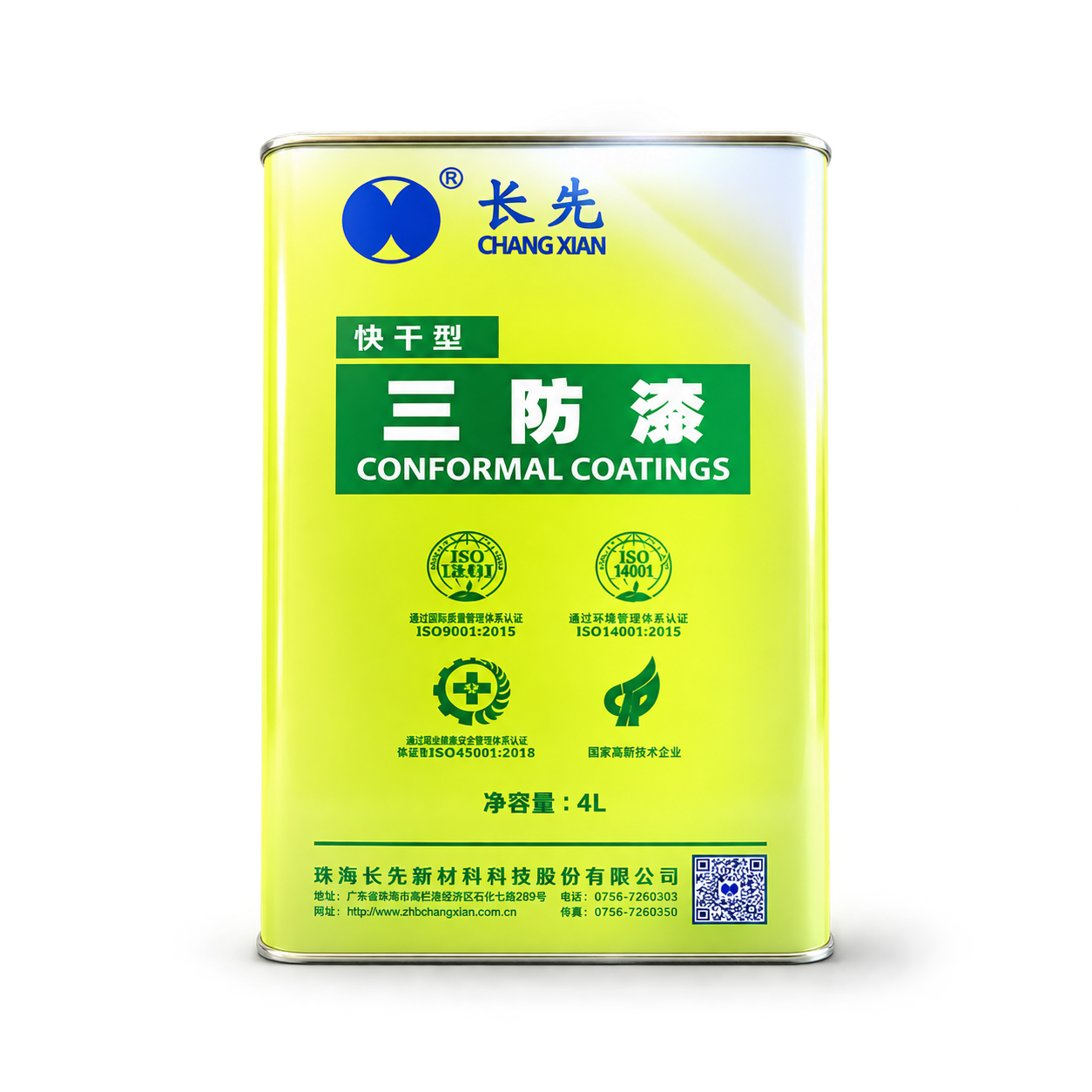
UV Conformal Coating Application & Selection Guide (Selection Guide by Application)
1. PCBs with Shadowed Areas: The Core Value of Dual Cure
Areas beneath tall components such as connectors, electrolytic capacitors and transformers are shadowed from UV light. M78-3068UV‘s moisture post-cure mechanism is designed exactly for these structures: exposed areas build a tack-free surface through second-level UV cure, while shadowed areas complete curing via moisture within 24–72 h. When selecting, confirm the shadowed area, coating thickness and your line’s ambient temperature and humidity, and factor shadowed-area cure time into your production scheduling.
2. High-Throughput Automated Lines: Second-Level Tack-Free
For spray or selective coating automated lines, the throughput bottleneck is usually the coating’s tack-free and cure waiting time. M78-3068UV completes UV cure in 20–25 s under recommended conditions; dry-surface cure on exposed areas requires a minimum intensity of 500 mW/cm². During qualification, validate intensity, lamp distance, exposure time and conveyor speed against your actual board design.
3. Thick-Film Circuits and Porous Substrates
The M78-3068UV TDS explicitly lists thick-film circuit systems and porous substrates as applicable. Porous substrates absorb the coating and affect cure depth; we recommend a combined validation of coating thickness, cure energy and adhesion using your actual substrates first.
4. Outdoor and Harsh Environments: Confirm Protection Boundaries with Data
If your PCB faces outdoor, coastal, high-humidity or thermal cycling environments, M78-3068UV‘s TDS reliability data provides a starting point for evaluation: 172 h salt spray, 10 days at 85°C/85%RH, 100 thermal shock cycles from -45°C to 135°C, and a service temperature of -55°C to +125°C. For conditions beyond these, please provide your specific environmental parameters and conduct application testing.
5. Spraying, Dipping, Brushing: Confirm the Process Window by Method
M78-3068UV supports spray, dip and brush application, with a viscosity of 180±30 mPa·s. Different application methods correspond to different wet-film thickness and leveling requirements; conduct application testing to confirm process conditions before use.
Changxian New Material UV Conformal Coating Product Parameters & Best-Fit Applications
| Model | Chemistry | Appearance / Viscosity | Cure Reference | Protection & Electrical Properties | Best-Fit Applications |
| M78-3068UV | One-part UV/moisture dual cure conformal coating | Colorless to pale yellow transparent liquid; viscosity 180±30 mPa·s (GB/T 1723-1993); density 1.0–1.1 g/cm³; non-volatile content 100% | UV dose 1,000–2,000 mJ/cm² (320–405 nm); moisture cure 24–72 h (25°C, 50% RH); 365 nm highly suitable, 395 nm suitable | Shore D 75–90; dielectric strength 75 kV/mm; volume resistivity 2.6×10¹⁶ Ω·cm; salt spray 172 h; 85°C/85%RH 10 days; 100 thermal shock cycles; UL 94 V-0 | Coating protection for PCBs with shadowed areas, thick-film circuit systems and porous substrates; spray, dip, brush and automated lines |
M78-3068UV Cure Reference Conditions
| Item | TDS Reference Condition | Notes |
| Recommended UV cure | High-pressure mercury lamp 30–50 mW/cm², 20–25 s | Recommended conditions from the typical cure performance table |
| UV dose range | 1,000–2,000 mJ/cm² (320–405 nm) | Given in the product parameter table |
| Dry-surface cure on exposed areas | Minimum 500 mW/cm²; 1,000 mW/cm² mercury or electrodeless lamps give better surface dryness | Insufficient intensity affects surface dryness |
| Shadowed-area moisture cure | At least 2–3 days (25°C, 50% RH); 72 h recommended at 25°C, 70% RH | Higher temperature and humidity accelerate curing |
M78-3068UV UV Lamp Wavelength Suitability
| UV lamp wavelength | 320 nm | 365 nm | 395 nm | 405 nm |
| Suitability | Not suitable | Highly suitable (++) | Suitable (+) | Not suitable |
UV Conformal Coating Comparison Considerations
Choosing a UV conformal coating is not simply about comparing “how fast it cures” — it is about confirming whether your board structure, protection targets, curing equipment, reliability requirements and total cost match. When evaluating, procurement and engineering teams should first confirm the following questions: How many shadowed areas are on the board? Can UV light cover the main coated surfaces? Is the reliability data behind your protection targets supported by a TDS? Does the moisture cure time match your production scheduling? How will fluorescence inspection be incorporated into quality control?
If your PCB has component shadowing, your line pursues high throughput, and you want to avoid the VOC emissions of solvent-based conformal coatings, M78-3068UV’s UV/moisture dual cure, 100% non-volatile content and second-level tack-free offer real qualification value. If your product requires long-term water immersion, continuous operating temperatures beyond -55°C to +125°C, or frequent coating rework, you should not choose based on “fast UV cure” alone — re-confirm the system or run additional application testing.
In terms of total cost, the value of a UV cure conformal coating comes not only from unit price, but also from shorter cure waiting, less work-in-process occupation, no solvent evaporation treatment, and higher automation throughput. Changxian New Material in-house resin synthesis, 20,000-ton annual capacity and factory-direct supply model can help you achieve a better overall cost balance across material procurement, sample validation, volume delivery and technical support.
How Are UV Conformal Coatings Used?
UV conformal coatings cure when triggered by UV light, providing PCB protection against moisture, fungus and salt spray, plus electrical insulation. The basic process is: clean and dry the board surface; apply by spray, dip or brush; irradiate exposed areas with a UV source of suitable wavelength; let shadowed areas stand to complete moisture cure; inspect fluorescent coverage with a UV inspection lamp; confirm cure integrity before moving to the next process step.
Unlike UV adhesives, UV conformal coatings are used for full-board or localized surface protection rather than structural bonding between components. If you need component fixing, wire harness reinforcement or plastic bonding, evaluate a UV adhesive separately.
What Are UV Conformal Coatings?
A UV conformal coating — also known as a UV curable conformal coating or UV cure conformal coating — is a type of circuit-board protective coating that cures rapidly under UV light. Common advantages include one-part formulation, solvent-free composition, fast tack-free and suitability for automated lines. Its core limitation is that light only reaches exposed surfaces — shadowed areas beneath components require a secondary cure mechanism such as moisture or heat, so a dual cure conformal coating is the safer choice for boards with shadowing.
The accurate selection statement is: provided UV light can cover the main coated surfaces and shadowed areas have a reliable secondary cure mechanism, a UV conformal coating can significantly shorten the waiting time of the protection process. Wavelength match, intensity, lamp distance, coating thickness and ambient temperature/humidity all affect final cure quality.
Conformal Coating Material Types
| Type | Strengths | Limitations & Confirmation Points |
| Acrylic conformal coating (AR) | Wide process window, fast tack-free, relatively easy rework and cost-friendly; a common choice for general PCB protection. | Chemical solvent resistance and long-term high-temperature/high-humidity resistance are usually weaker than polyurethane or UV systems. |
| Polyurethane conformal coating (UR) | Better moisture, fungus, chemical and abrasion resistance; suitable for power boards, industrial control and outdoor electronics. | Longer drying and full cure time; rework is more difficult; high-throughput lines should confirm whether cure time matches the process. |
| Silicone conformal coating (SR) | Flexible with a wide high/low temperature range; suitable for thermal stress and vibration scenarios. | Low surface energy with average abrasion and adhesion; cost and rework need evaluation. |
| UV/moisture dual cure conformal coating | Exposed areas cure in seconds under UV; shadowed areas are post-cured by moisture; solvent-free with fast cycle time; suitable for PCBs with component shadowing and automated lines. Changxian New Material M78-3068UV belongs to this system. | Requires UV curing equipment and intensity management; shadowed areas need 24–72 h for full cure, which should be factored into production scheduling. |
The types above help you and your engineering team understand the selection logic. This page features M78-3068UV, a one-part UV/moisture dual cure conformal coating; for other conformal coating needs, see the Changxian New Material conformal coating guide.
UV Conformal Coating vs. Other Curing Systems: Cure Speed Comparison
If you are evaluating the throughput of your conformal coating process, the curing system’s tack-free speed often affects total cost more than material unit price. The table below compares typical time ranges from representative public TDS documents of each system, helping you judge how much waiting time the “second-level tack-free” of a UV conformal coating can save your line.
| Curing System | Typical Tack-Free / Set Time | Typical Full Cure Time | Impact on Line Throughput | Better-Suited Scenarios |
| UV/moisture dual cure conformal coating (M78-3068UV’s system) | Exposed areas: UV cure 20–25 s (30–50 mW/cm² high-pressure mercury lamp) | Exposed areas complete with irradiation; shadowed areas moisture cure 24–72 h | Second-level tack-free; boards can move immediately to the next step; shadowed areas need moisture cure time to build full performance | PCBs with component shadowing, automated high-throughput lines |
| Solvent-based acrylic conformal coating | Tack-free approx. 10–30 min | Full performance typically takes days | Requires flash-off zone, ventilation and waiting; occupies work-in-process | Repair, small batches, lines without UV equipment |
| Heat-cure conformal coating | Oven heating required, tens of minutes to hours | Completes with heat cure | Occupies ovens; energy consumption and thermal management costs | Thick films, many shadowed areas, scenarios without UV equipment |
| Moisture-cure silicone (RTV) | Tack-free approx. 5–30 min | Approx. 2–4 mm/24 h; thick sections take days | Slow surface-to-depth cure; slowest cycle | Protection scenarios requiring flexibility and wide temperature resistance |
Data sources and boundaries: the times above are typical ranges from representative public TDS documents of each system, provided for selection comparison only — they do not represent any specific grade; for a specific grade, refer to the latest TDS of both sides. “Second-level” for UV conformal coatings refers to tack-free of UV-exposed areas; full cure of shadowed areas still requires 24–72 h. Other systems have their own strengths in scenarios without UV equipment, with thick films or requiring flexible protection — this page presents cure-speed differences only and does not disparage any system.
Common UV Conformal Coating Application Issues and Solutions
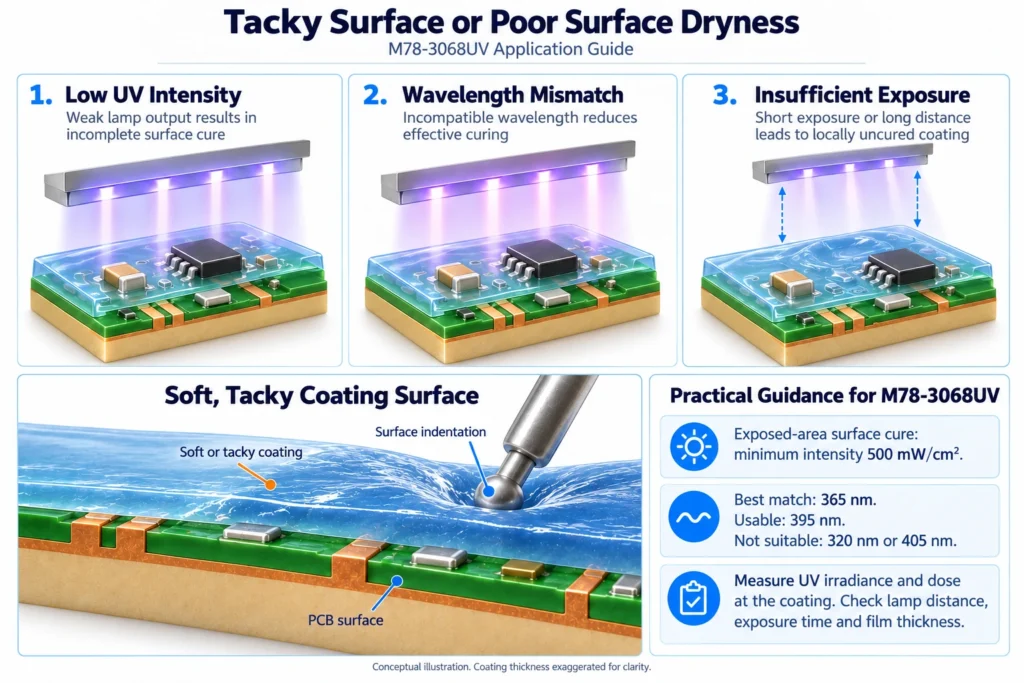
1. Tacky Surface or Poor Surface Dryness
Possible causes:
insufficient intensity (dry-surface cure on exposed areas requires a minimum of 500 mW/cm²), wavelength mismatch, lamp distance too far, insufficient exposure time, or a coating applied too thick.
Suggestion:
measure the actual energy reaching the coating with a suitable radiometer; 365 nm is the best-match wavelength, 395 nm is usable, and 320 nm and 405 nm are not suitable; validate curing with your actual board design and equipment.
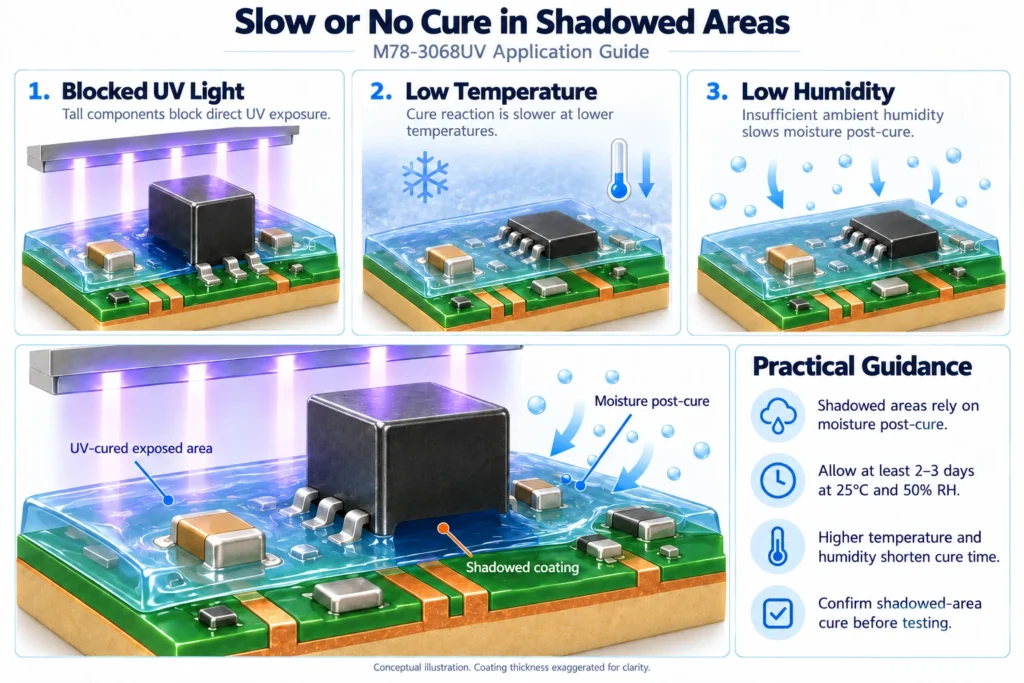
2. Slow or No Cure in Shadowed Areas
Possible causes:
components, connectors or tall devices blocking the light source; ambient temperature and humidity too low, slowing moisture cure.
Suggestion:
shadowed areas rely on moisture post-cure — at least 2–3 days at 25°C, 50% RH; higher ambient temperature and humidity shorten the time; schedule production and testing only after shadowed-area cure is complete.
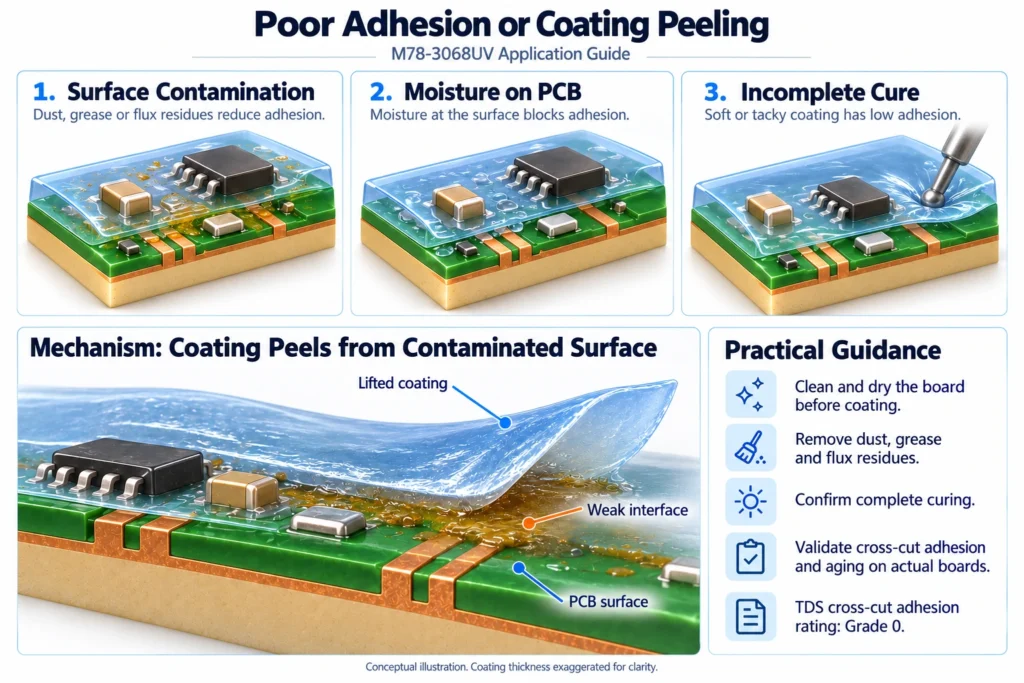
3. Poor Adhesion or Coating Peeling
Possible causes:
oil, dust, flux residue or moisture on the board surface; incomplete curing.
Suggestion:
ensure the surface is dry and free of dust, grease and other contaminants before coating; run cross-cut adhesion and aging validation on your actual boards (the TDS adhesion rating is cross-cut Grade 0).
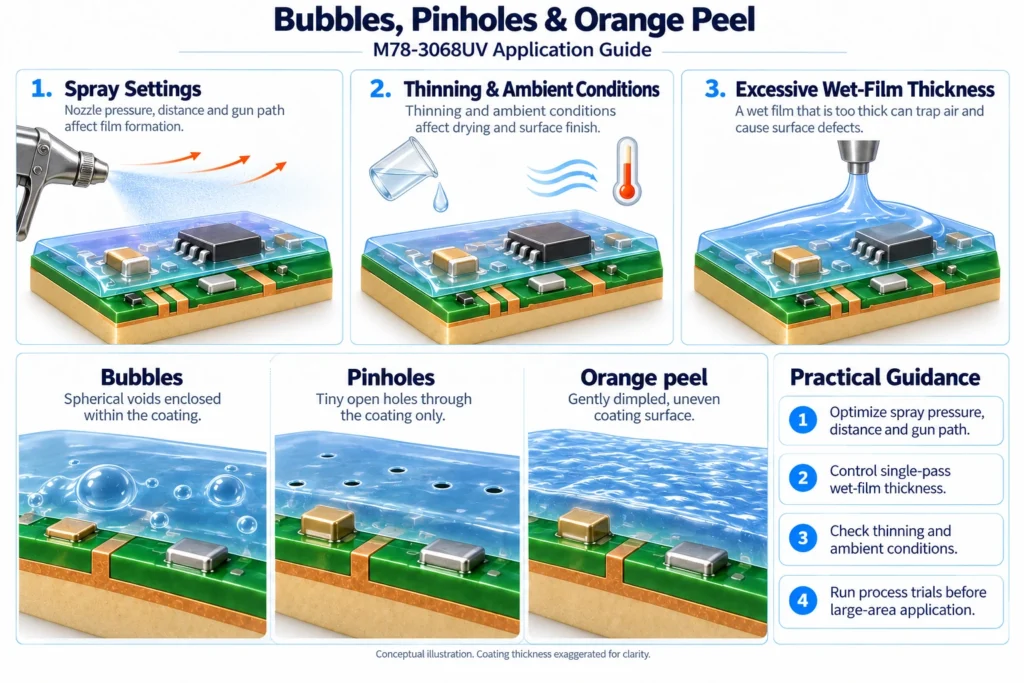
4. Bubbles, Pinholes or Orange Peel
Possible causes:
inappropriate spray pressure or distance, improper thinning, abnormal ambient temperature/humidity during application, or a single coat applied too thick.
Suggestion:
optimize spray parameters and gun path; control single-pass wet-film thickness; run process trials before large-area application.
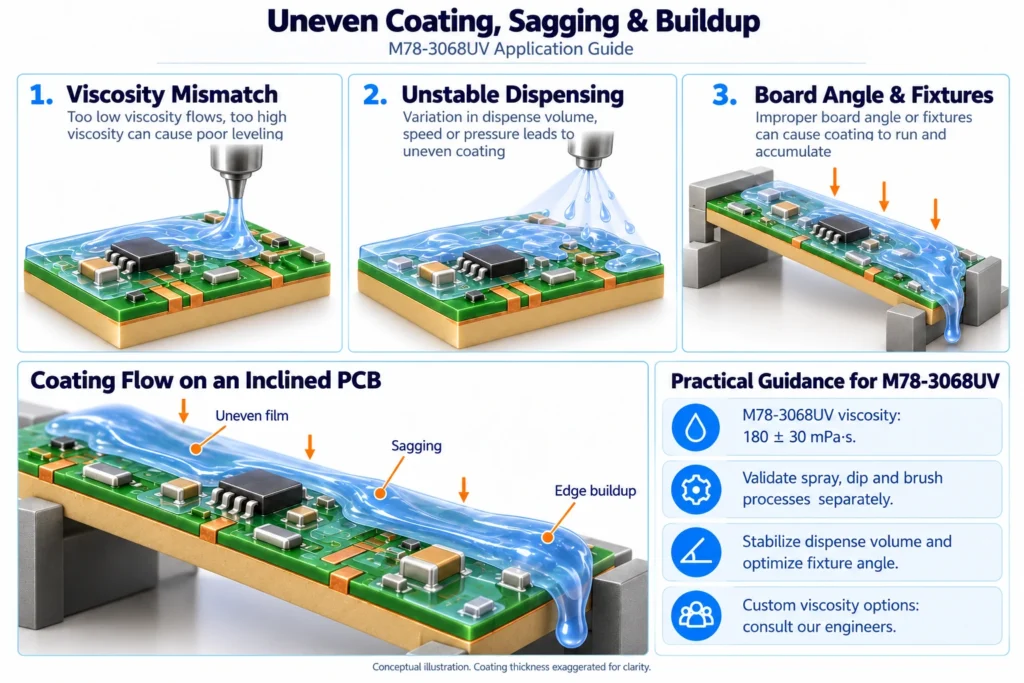
5. Uneven Coating, Sagging or Buildup
Possible causes:
viscosity mismatched to the application method, unstable dispense volume, or unreasonable board angle or fixture design.
Suggestion:
M78-3068UV has a viscosity of 180±30 mPa·s, a low-viscosity system; confirm the process window separately for spray, dip or brush application; if you have specific viscosity requirements, consult our engineers — we can customize production for you.
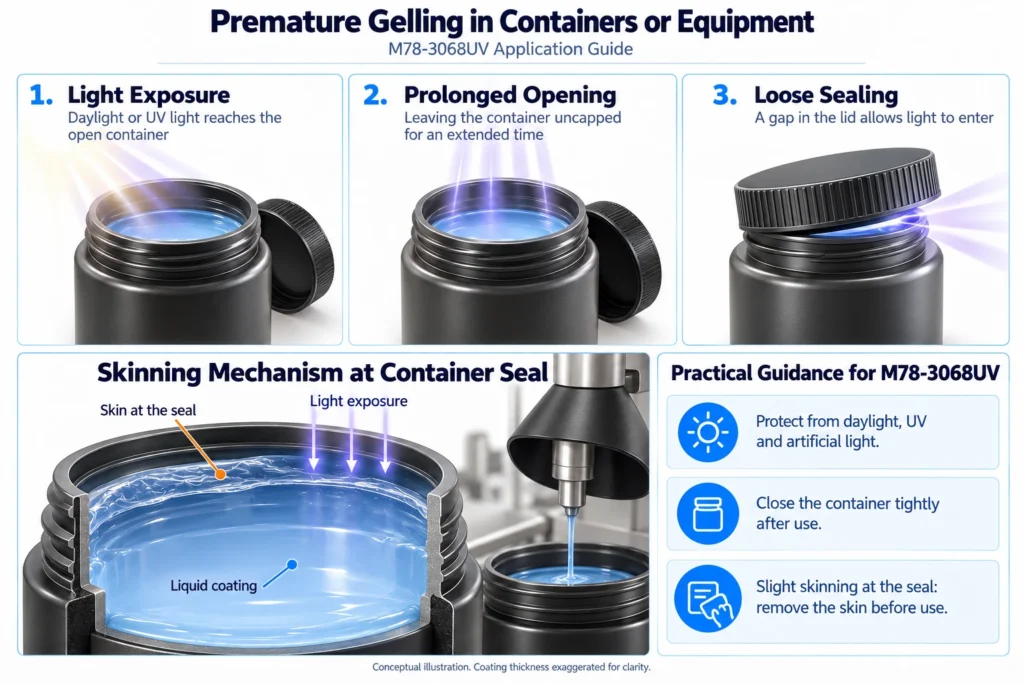
6. Premature Gelling in the Container or Equipment
Possible causes:
exposure to daylight, UV or artificial light sources; prolonged exposure after opening; loose container sealing.
Suggestion:
protect from light during storage and handling; tighten the container cap immediately after application; if slight skinning occurs at the seal, the material can be used normally after removing the skin.
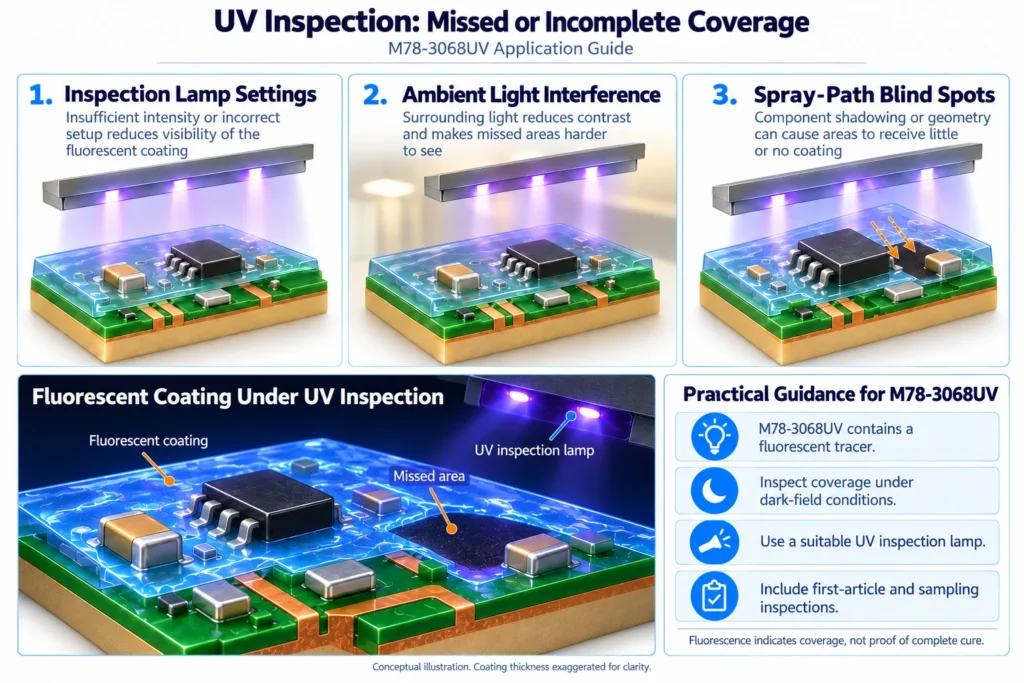
7. UV Inspection Reveals Missed or Incomplete Coverage
Possible causes:
unsuitable inspection lamp wavelength or illuminance, ambient light interference during inspection, or blind spots in the spray path.
Suggestion:
M78-3068UV contains a fluorescent tracer; inspect coverage integrity under dark-field conditions with a suitable UV inspection lamp, and incorporate fluorescence inspection into first-article and sampling procedures.
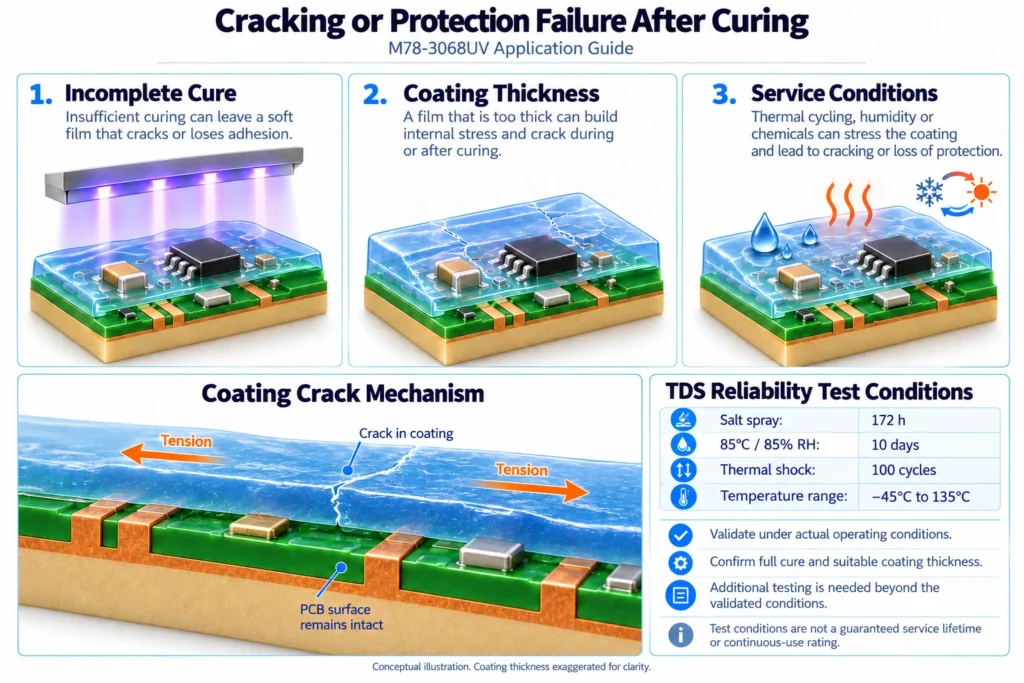
8. Cracking or Protection Failure After Curing
Possible causes:
incomplete curing, unreasonable coating thickness design, or actual thermal shock or chemical exposure beyond the validated range.
Suggestion:
complete validation under your actual operating conditions; TDS reliability data covers 172 h salt spray, 10 days at 85°C/85%RH and 100 thermal shock cycles from -45°C to 135°C — environments beyond this range require additional application testing.
UV Conformal Coating Buying Guide FAQ
Q1: What is a UV conformal coating?
A UV conformal coating (also called a UV curable conformal coating) is a circuit-board protective coating that cures rapidly under UV light, protecting PCBs against moisture, fungus and salt spray while providing electrical insulation. It suits high-throughput automated lines; boards with shadowed areas should use a UV/moisture dual cure conformal coating system.
Q2: What is M78-3068UV used for?
M78-3068UV is a one-part UV/moisture dual cure conformal coating for thick-film circuit systems, porous substrates and printed circuit boards. It protects circuit boards and related equipment from environmental erosion, and is especially suitable for boards with shadowed areas.
Q3: How fast does M78-3068UV cure?
Exposed areas complete UV cure in about 20–25 s under a high-pressure mercury lamp at 30–50 mW/cm²; dry-surface cure on exposed areas requires a minimum UV intensity of 500 mW/cm², and 1,000 mW/cm² mercury or electrodeless lamps give better surface dryness. Shadowed areas rely on moisture cure — at least 2–3 days at 25°C, 50% RH.
Q4: Will M78-3068UV cure in shadowed areas?
Yes. M78-3068UV is a UV/moisture dual cure system: shadowed areas that UV light cannot reach are post-cured by atmospheric moisture; the recommended condition is 72 h at 25°C, 70% RH (the parameter table gives 24–72 h at 25°C, 50% RH). Factor shadowed-area moisture cure time into your production cycle when scheduling.
Q5: Which application methods does M78-3068UV support?
The TDS lists spray, dip and brush application, with a viscosity of 180±30 mPa·s. Conduct application testing before use to confirm the process conditions suit your line.
Q6: Is M78-3068UV suitable for selective coating or automated lines?
It can be evaluated. The low-viscosity system and second-level UV tack-free suit automated and selective coating lines, but qualification requires confirming spray parameters, wet-film thickness, intensity, lamp distance and exposure time on your actual boards, and validating moisture cure in shadowed areas.
Q7: Does M78-3068UV require mixing?
No. M78-3068UV is a one-part product requiring no weighing or mixing; 100% non-volatile content, zero VOCs, zero HAPs, low odor, free of benzene solvents, acetone and other toxic substances. Simply protect from light during storage and handling.
Q8: What protection performance does M78-3068UV provide?
Reliability data from the TDS: salt spray at 35°C, 5% NaCl for 172 h with no blistering, peeling or wrinkling and no substrate corrosion (GB/T 2423.17-2008); 10 days at 85°C, 85% RH with no film abnormality; 100 thermal shock cycles of -45°C/30 min ↔ 135°C/30 min with no delamination, blistering or cracking (IPC-CC-830B-2002). The cured product’s service temperature range is -55°C to +125°C.
Q9: What electrical properties does it provide?
After curing: dielectric strength 75 kV/mm, volume resistivity 2.6×10¹⁶ Ω·cm, dielectric constant 3.25 (1 MHz) and dissipation factor 0.01 (1 MHz) — usable for electrical insulation evaluation.
Q10: Is M78-3068UV waterproof?
The TDS reports water absorption ≤0.3%, which can serve as a reference for moisture resistance, but cannot be used to directly claim waterproofing, long-term immersion resistance or an IP rating. If you have waterproofing, immersion or long-term damp-heat requirements, please provide your specific operating conditions and conduct application validation.
Q11: How should surfaces be prepared before coating?
For best adhesion, the surface to be coated must be dry and free of dust, grease and other contaminants. We recommend coating, curing and reliability testing on your actual production boards.
Q12: How do you inspect coating coverage?
M78-3068UV contains a fluorescent tracer; after curing, coverage integrity can be inspected under dark-field conditions with a UV inspection lamp, making it easy to spot missed areas, thin areas and buildup.
Q13: Can the cured coating be reworked or removed?
The TDS does not specify rework methods for the cured coating. If your product requires repair or rework, consult our engineers to evaluate feasible rework options based on your board material and components.
Q14: Are samples and compliance documents available?
Samples and M78-3068UV TDS, MSDS, RoHS, REACH and California Proposition 65 documents are available. The RoHS report (SGS, CANEC26012627903, 2026-05-28) and REACH SVHC report (CANEC26012627905) both conclude Pass, with M78-3068UV included in the client reference information; the Prop 65 report (CANEC26021086601) lists M78-3068UV as the tested sample. Flame rating UL 94 V-0, UL Product iQ file number E513343 (category QMJU2).
Q15: What are the packaging, storage and shelf life?
Packaging: 1 L/pail, 4 L/pail. Storage: keep sealed in a light-protected, cool, dry and ventilated environment (0–30°C); shelf life is generally 6 months from the date of manufacture; product beyond its shelf life should be confirmed free of abnormalities before use.
Q16: What is the difference between UV conformal coating and UV adhesive?
UV conformal coating is used for full-board or localized surface protection of PCBs, focusing on moisture, fungus and salt spray resistance, insulation and coverage integrity; UV adhesive is used for localized bonding such as component fixing, wire harness reinforcement and plastic bonding. Both cure quickly under UV, but their application goals differ — a conformal coating cannot replace structural bonding, and a UV adhesive cannot take on full-board protection.
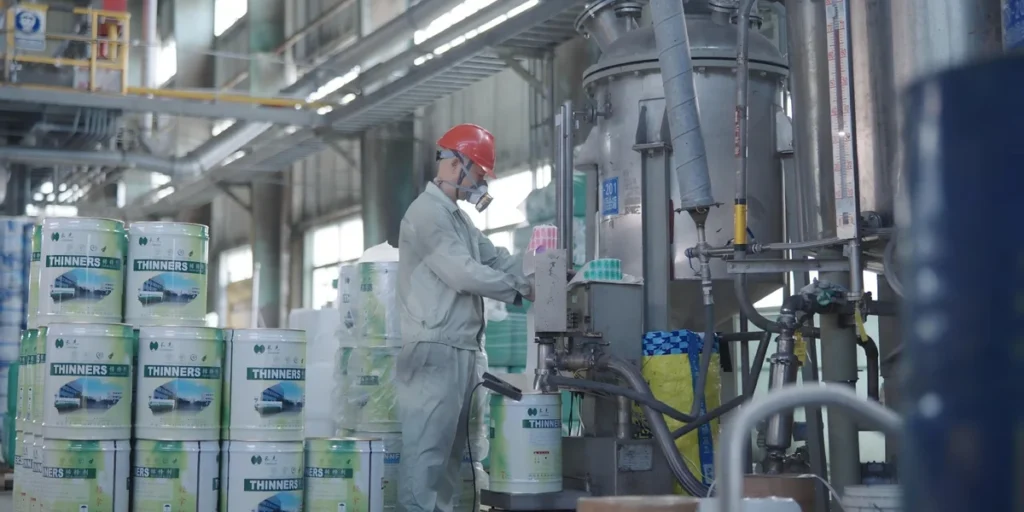

Advantages of Changxian New Material UV Conformal Coating
· UV/moisture dual cure: exposed areas cure in seconds under UV light; shadowed areas that UV cannot reach are post-cured by moisture — suitable for PCBs with component shadowing.
· Fast production cycle: a high-pressure mercury lamp at 30–50 mW/cm² completes UV cure in 20–25 s; once tack-free, boards can move immediately to the next process step.
· Solvent-free formulation: 100% non-volatile content, zero VOCs, zero HAPs, low odor, free of benzene solvents, acetone and other toxic substances.
· Clear reliability data: 172 h salt spray (35°C, 5% NaCl), 10 days at 85°C/85%RH, 100 thermal shock cycles, service temperature from -55°C to +125°C.
· Electrical performance: dielectric strength 75 kV/mm, volume resistivity 2.6×10¹⁶ Ω·cm, dielectric constant 3.25 (1 MHz).
· Flame retardance and compliance: UL 94 V-0; compliant with RoHS, REACH and halogen-free requirements (Cl and Br both <700 ppm); Prop 65 report available.
· Fluorescent tracer: after curing, coverage integrity can be inspected under a UV inspection lamp, making coating quality control easier.
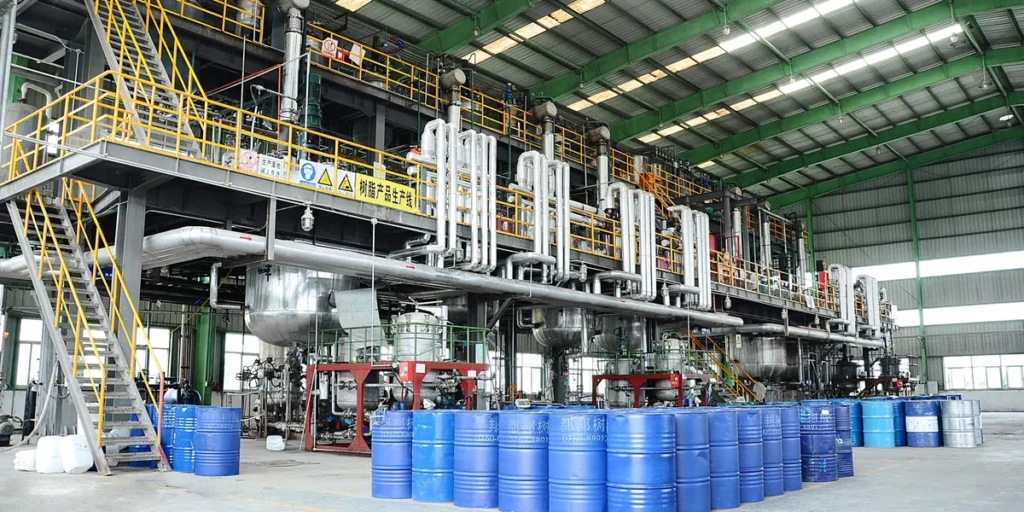
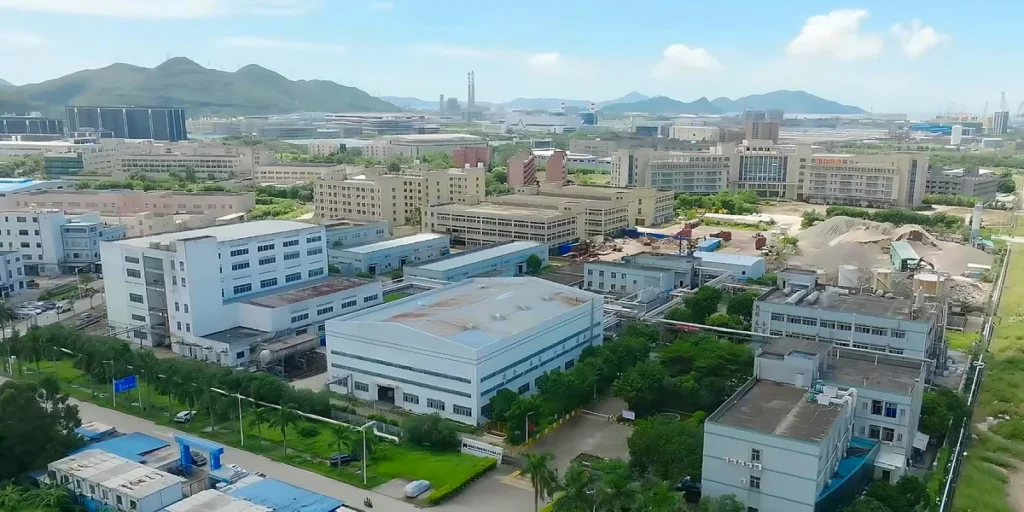
· China factory advantage: 40,000 m² production base, a mature electronic chemicals supply chain and export support capability provide you with stable, efficient delivery.
· Factory-direct cost advantage: in-house resin synthesis, 20,000-ton annual capacity and factory-direct supply help you control procurement and qualification costs without compromising quality.
· Compliance and onboarding support: TDS, MSDS, RoHS, REACH and California Proposition 65 documents available, with sample testing and engineering selection support.
Whether your priority is increasing conformal coating line throughput, solving shadowed-area cure, stabilizing coating quality, or balancing reliability, compliance documentation and total cost, Changxian can help you evaluate across five dimensions: material system, curing equipment, process validation, compliance documentation and total cost.
Contact us
Not sure whether M78-3068UV fits your board design and production line?
Send Changxian New Material your board photos or drawings, shadowed-area locations, coating method, UV equipment parameters, target cycle time, and protection and reliability requirements.
Our engineers can help evaluate the cure window, coating process and test items, and provide samples, TDS, MSDS, RoHS, REACH, Prop 65 and UL documentation for qualification.
Technical Support & OEM Inquiries
Related Products