Conformal Coating Guide
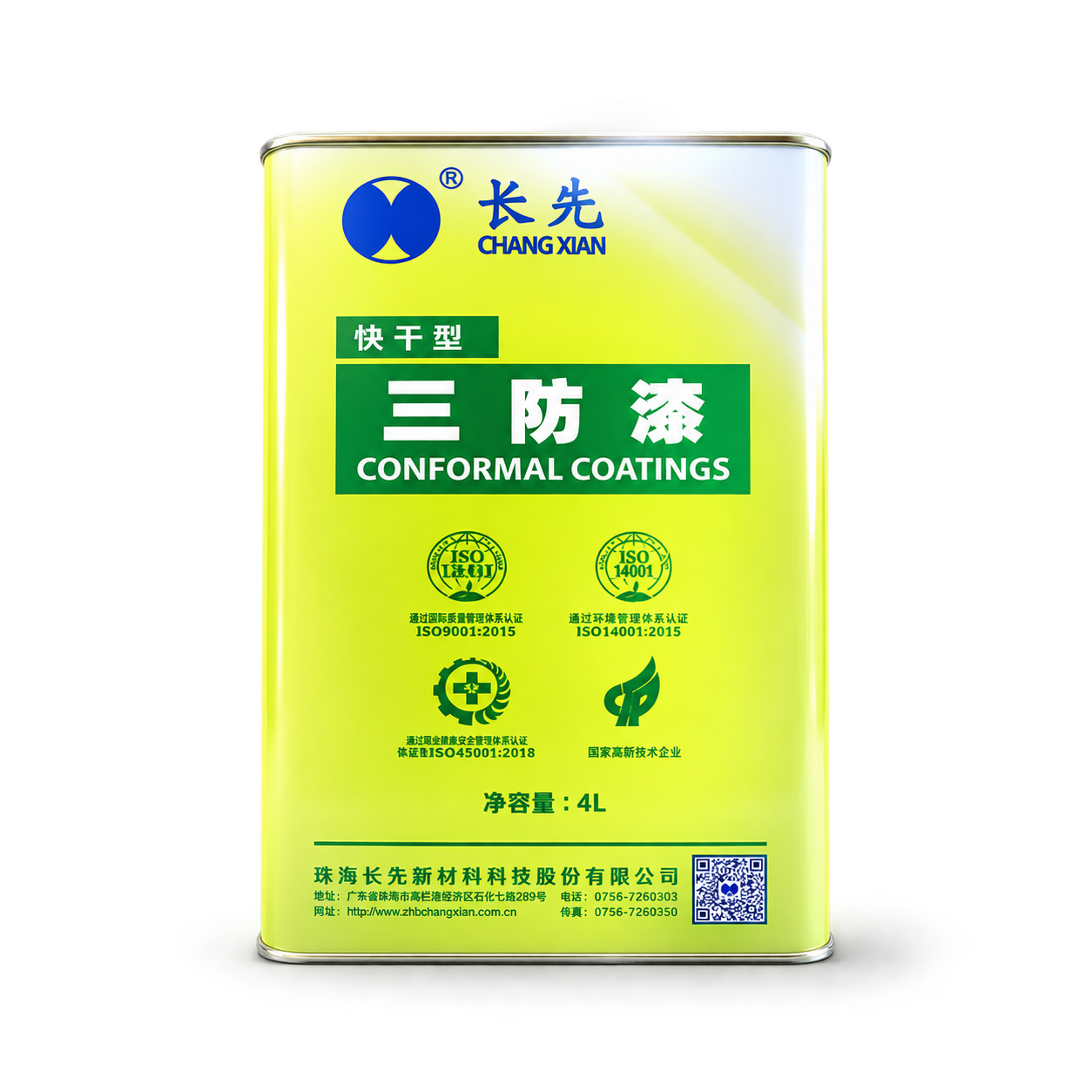
Conformal Coating Guide for PCB Protection
Changxian New Material provides conformal coating solutions for PCBs, electronic components and electrical assemblies. Our coatings help protect your products against moisture, dust, salt spray, corrosive gases, chemical contamination and thermal shock, supporting stable electrical performance, lower failure risk and longer product life.
You can select from acrylic, polyurethane, water-based polyurethane and UV/moisture dual-cure systems according to your protection level, flexibility, curing speed, rework needs and production efficiency. With a 40,000 m² manufacturing base in China, in-house resin synthesis, 20,000-ton annual capacity and factory-direct supply, Changxian New Material supports your production with stable delivery, fast response and competitive total cost. UL E513343, RoHS, REACH, TDS and MSDS documents are available by model to support your validation and production introduction.
Conformal Coating Selection Guide by Chemistry
1. Acrylic Conformal Coating: Low Odor, Process Efficiency and Fluorescent Inspection
Choose an acrylic conformal coating when your PCB protection calls for fast touch drying, transparent protective films, fluorescent inspection and broad process adaptability. Changxian New Material acrylic options you can evaluate include:
M788-1 Modified Acrylic Conformal Coating
Features: one-component modified acrylic system, aromatic-solvent-free and low odor. It forms a transparent, glossy film with moisture, dust and sulfurization resistance, flexibility and weather resistance. Fluorescent tracer supports UV inspection. It can air dry or be accelerated by heat.
Best for: consumer electronics, industrial controls, power boards and PCBs requiring a transparent protective film, fluorescent inspection and conventional moisture, dust and sulfurization protection.
M988 Silicone-Modified Acrylic Conformal Coating
Features: formulated with silicone-modified acrylic resin, alcohol-ether environmentally friendly solvents and special additives. It is a one-component, low-odor, low-toxicity product free of aromatic solvents and acetone. It contains fluorescent tracer and supports brushing, dipping and spraying.
Best for: moisture protection of electronic and electrical components, especially processes that use both silicone potting and conformal coating, where it can improve interface drying problems caused by incompatible systems.
2. Polyurethane (Urethane) Conformal Coating: Chemical Resistance, Moisture Protection and Insulation
Choose a polyurethane conformal coating when your PCBs and electronic assemblies need higher moisture resistance, mold resistance, chemical resistance, adhesion and insulation resistance. Changxian New Material models you can evaluate include:
M78H-41 Polyurethane Conformal Coating
Features: modified polyurethane system forming a transparent, glossy, hydrophobic protective film with high insulation resistance and a PASS result for sulfurization resistance testing.
Best for: PCBs, electronic components and metal surfaces in humid, large-temperature-difference, sulfur-containing or high-insulation-requirement environments.
M78H-86 Polyurethane Conformal Coating
Features: one-component oxidation-curing system with low viscosity, suitable for brushing, dipping and spraying. The TDS reports no blistering, whitening, cracking or rust after 72 hours of neutral salt spray testing.
Best for: power PCBs, industrial electronics and assemblies with higher requirements for moisture resistance, salt spray performance and electrical properties.
3. Water-Based Polyurethane Conformal Coating: Low Odor and Environmental Process
If your factory prioritizes odor control, safety and lower organic solvent consumption, consider a water-based conformal coating. Before you decide, confirm your drying time, humidity control, wastewater handling and rework method.
M888 Water-Based Polyurethane Conformal Coating
Features: waterborne polyurethane system with very low odor, non-flammable and non-explosive handling, and viscosity adjustment with deionized water. Suitable for brushing and dip coating.
Best for: electronic and electrical products that require moisture, mold and corrosion protection with higher requirements for odor, safety and environmental process.
4. UV-Cure Conformal Coating: Speed and Automated Production
If your production line is high-volume, automated and cycle-time-sensitive, a UV conformal coating is the right fit. If your PCBs have significant component shadowing, choose a UV/moisture dual-cure system.
M78-3068UV Dual-Cure UV Conformal Coating
Features: UV/moisture dual cure. Exposed areas cure rapidly under UV, while shadowed areas continue curing through moisture. Fluorescent tracer supports coverage inspection.
Best for: high-throughput electronics manufacturing, automated spraying, densely populated PCBs and assemblies with shadowed areas.
Conformal Coating Product Comparison
| Model | Chemistry | Drying / Curing Speed | Temperature | Salt Spray | Best-Fit Scenario |
| M788-1 | One-component modified acrylic | RT touch dry ≤30 min, full dry 24 h; 80°C touch dry 3–10 min, full dry 2–3 h; best performance about 7 days | -20°C to +120°C | 5% NaCl, 35±2°C, 72 h: no corrosion, no blistering, whitening, cracking or rust | Low odor, transparent film, fluorescent inspection, conventional moisture/dust/sulfurization protection |
| M988 | Silicone-modified acrylic | 30°C / 55% RH touch dry 30–40 min, full dry 24 h; 80°C touch dry 3–10 min, full dry 2–4 h; best performance about 7 days | -40°C to +120°C | 5% NaCl, 35±2°C, 72 h: no corrosion, no blistering, whitening, cracking or rust | Moisture protection for electronic and electrical components; suitable for processes combining silicone potting and conformal coating |
| M78H-41 | Modified polyurethane | RT touch dry ≤30 min, full dry 24 h; 80°C touch dry 5–10 min, full dry 2 h | -40°C to +120°C | 5% NaCl, 35±2°C, 72 h: no corrosion, no blistering, whitening, cracking or rust | PCBs, electronic components and metal surfaces in humid, large-temperature-difference or sulfur-risk environments |
| M78H-86 | Modified polyurethane | 25°C / 55% RH touch dry 5–15 min; 60–80°C touch dry ≤5 min; best performance about 7 days | -40°C to +125°C | 5% NaCl, 35±2°C, 72 h: no corrosion, no blistering, whitening, cracking or rust | Power PCBs, industrial electronics and assemblies requiring higher salt spray and electrical performance |
| M888 | Water-based polyurethane | 25°C touch dry about 60 min; 80°C touch dry ≤10 min, full dry 3–5 h; best performance about 7 days | -40°C to +125°C | 5% NaCl, 35±2°C, 96 h: no corrosion, no blistering, whitening, cracking or rust | Electronic and electrical products with higher requirements for low odor, safety and environmental process |
| M78-3068UV | UV / moisture dual cure | UV cure reference 1000–2000 mJ/cm²; moisture cure 24–72 h; shadowed areas should be evaluated for at least 2–3 days | -55°C to +125°C | 5% NaCl,35±2°C, 172 h: no corrosion, no blistering, whitening, cracking or rust | Automated mass production, densely populated PCBs, shadowed areas and fluorescent inspection needs |
Conformal Coating Comparison Considerations
Choosing the right conformal coating is not about ranking chemistries from best to worst. It is about finding the best fit for your material requirements, certification needs, environmental exposure and production capability. Before you decide, confirm whether UL or IPC-related documents are required, whether your product will face humidity, salt spray, mold, chemical contamination or thermal shock, whether your line uses brushing, dipping, spraying, selective coating or UV curing, and how important reworkability is for you. For example, an indoor control board may not require extreme protection; an easy-to-apply, inspectable and reworkable acrylic conformal coating may be sufficient. By contrast, automotive electronics, outdoor power supplies or high-salt-spray environments require stronger chemical resistance, adhesion, environmental reliability and curing speed.
1. Acrylics (AR) are suitable for mild to moderately demanding environments involving humidity, dust, mold, occasional salt spray and general electrical insulation. Their advantages are a wide process window, fast touch drying, cost-friendliness and relatively convenient rework. They can also be formulated as transparent films with fluorescent tracer for coverage inspection. Their limitation is that chemical solvent resistance and long-term high-temperature/high-humidity resistance are usually weaker than polyurethane or UV systems. You can evaluate Changxian New Material models M788-1 and M988.
2. Polyurethane (UR) coatings build on acrylic protection with stronger moisture resistance, mold resistance, chemical resistance, abrasion resistance and adhesion. They are suitable for power boards, industrial controls, outdoor electronics and assemblies with higher sulfur or salt spray risk. The trade-off is longer drying and full-cure time, as well as more difficult rework. For high-volume, high-speed lines, confirm whether the cycle time matches your process. You can evaluate Changxian New Material models M78H-41 and M78H-86.
3. Water-based polyurethane systems are suitable if your factory has higher requirements for odor, safety, organic solvent use and environmental compliance. They can reduce workplace odor and flammable-solvent handling pressure, but they are not a zero-process-change option. Water removal is affected by temperature, humidity, airflow and film thickness; full drying and property development usually take longer, and your spraying and rework methods should be validated first. Changxian New Material model you can evaluate: M888.
4. UV cure coatings offer unmatched cycle-time advantages. Exposed areas can cure rapidly under the correct wavelength and dose, making them suitable for your automated, high-volume production. For shadowed areas under components, select a UV/moisture dual-cure system and include shadow-area curing in your release criteria. Limitations include equipment investment, light-source management, dose measurement and board-geometry evaluation. Complete a full cost-benefit analysis for your line before adoption. Changxian New Material model you can evaluate: M78-3068UV.
Therefore, do not base your conformal coating selection on a single parameter. Evaluate your protection environment, certification requirements, application method, curing cycle, rework strategy and total cost together. Changxian New Material can help you select a suitable system according to your PCB structure, production line conditions and target market, and provide samples, TDS, MSDS, RoHS, REACH and UL documents for your validation.
How Are Conformal Coatings Used?
Conformal coatings are used to help your PCBs and electronic assemblies resist common environmental stresses such as moisture, dust, dirt, mold, chemical vapors and corrosive gases, thereby extending product life. The cured coating provides useful dielectric properties that help reduce leakage, short circuits and flashover risk, supporting more compact and higher-power-density electronic designs.
Changxian New Material provides multi-chemistry conformal coating solutions for circuit board protection, covering acrylic, polyurethane, water-based polyurethane and UV/moisture dual-cure systems. The coatings can be matched to brushing, dipping, spraying, selective coating and UV curing processes. Whatever your priority — moisture insulation, salt spray reliability, low odor, fast curing or total cost — you can complete your evaluation with samples, TDS, MSDS, RoHS, REACH and UL documents before production validation.
What Are Conformal Coatings?
Conformal coatings are transparent or translucent protective coatings that conform to the complex geometry of a PCB. They are applied over circuit boards, solder joints, components and metal surfaces to improve environmental adaptability and long-term reliability. A conformal coating is not simply a waterproof glue, and it should not be equated directly with an enclosure IP rating. Final protection depends on material system, surface cleanliness, coverage integrity, film thickness, curing completeness and your overall product design.
Conformal Coating Material Types
Industry standards such as IPC-CC-830C list multiple conformal coating material families. For you, the key is not which system is absolutely best, but which system best fits your product environment and production process. The table below summarizes the four systems emphasized on this Changxian New Material page.
| Material | Advantages | Disadvantages |
| Acrylic (AR) | Wide process window, fast touch drying, transparent film, fluorescent inspection options, relatively convenient rework, friendly total cost | Chemical solvent resistance and long-term high-temperature/high-humidity resistance are usually weaker than polyurethane or UV systems |
| Polyurethane (UR) | Moisture, mold, chemical, abrasion and adhesion resistance; suitable for higher reliability requirements | Longer full-cure time, more difficult rework, cycle time must be confirmed for high-speed lines |
| Water-Based Polyurethane | Low odor, non-flammable and non-explosive handling, dilutable with deionized water, suitable for workshops with higher environmental and safety requirements | Drying is more affected by temperature, humidity, airflow and film thickness; full property development takes longer; spraying and rework require validation |
| UV Cure | Very fast curing, suitable for automation and mass production; dual-cure options can address shadowed areas; fluorescent inspection supported | Requires UV equipment and process monitoring; shadowed areas cannot be judged by surface dryness alone; higher equipment investment and rework difficulty |
Selecting the right system usually comes back to three questions: What certifications or compliance documents do you need? What is your main protection target? What application and curing capability does your production line have? Base your final selection on complete requirements, sample testing and process validation. Send your PCB type, application process, target film thickness, curing conditions and environmental requirements to our engineers, and we will help you choose a more suitable conformal coating solution.
Common Conformal Coating Defects and Solutions
Why Coating Defects Happen
Conformal coating quality is governed by three variables: the board surface condition, the rheology of the coating material, and the curing process parameters. When any one of them deviates, defects such as bubbles, blushing, runs and delamination appear. That is why troubleshooting should never focus on the coating material alone — you need to trace the problem across the full process chain, from surface preparation through coating to curing.
Six Common Coating Defects: Symptoms, Causes and Solutions
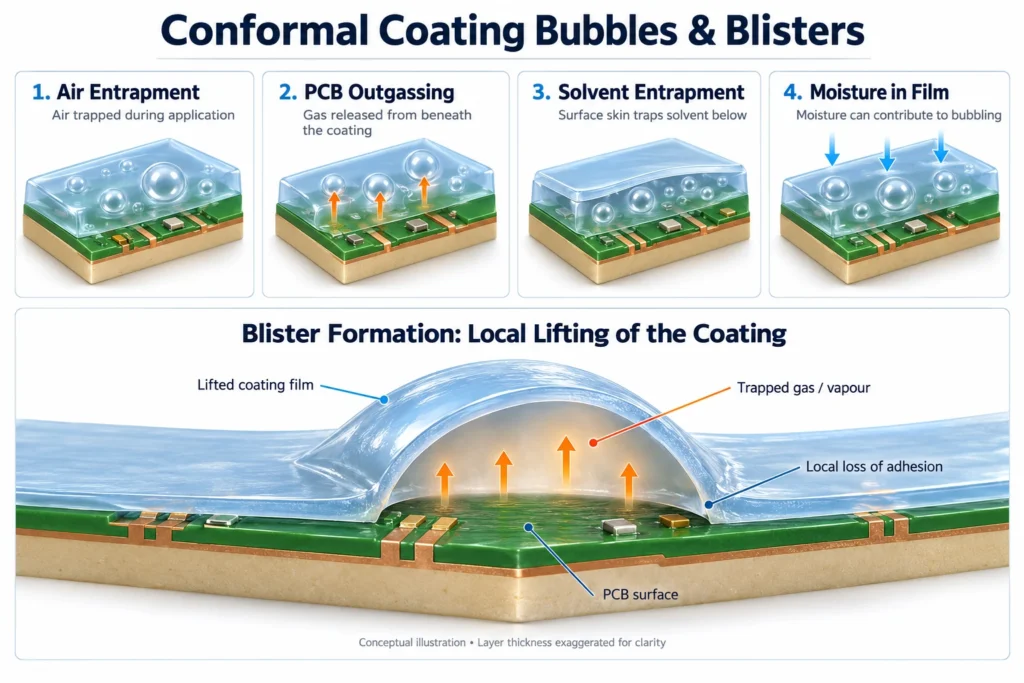
1. Bubbles in the Coating
Symptom: Bubbles of various sizes appear on the coating surface; they form blisters after curing and, in severe cases, cause the coating to peel.
Causes:
· Moisture or solvent remaining on the board surface expands when heated after coating, forming bubbles;
· A single coat applied too thick — the surface cures first and seals the solvent evaporation path, trapping solvent underneath;
· The curing temperature ramps up too fast, so the solvent vaporizes too quickly to escape.
Troubleshooting & solution:
Coat a fully dried bare board for comparison — if no bubbles appear, the pre-treatment drying was insufficient; if bubbles still appear, check the coating thickness and curing temperature profile.
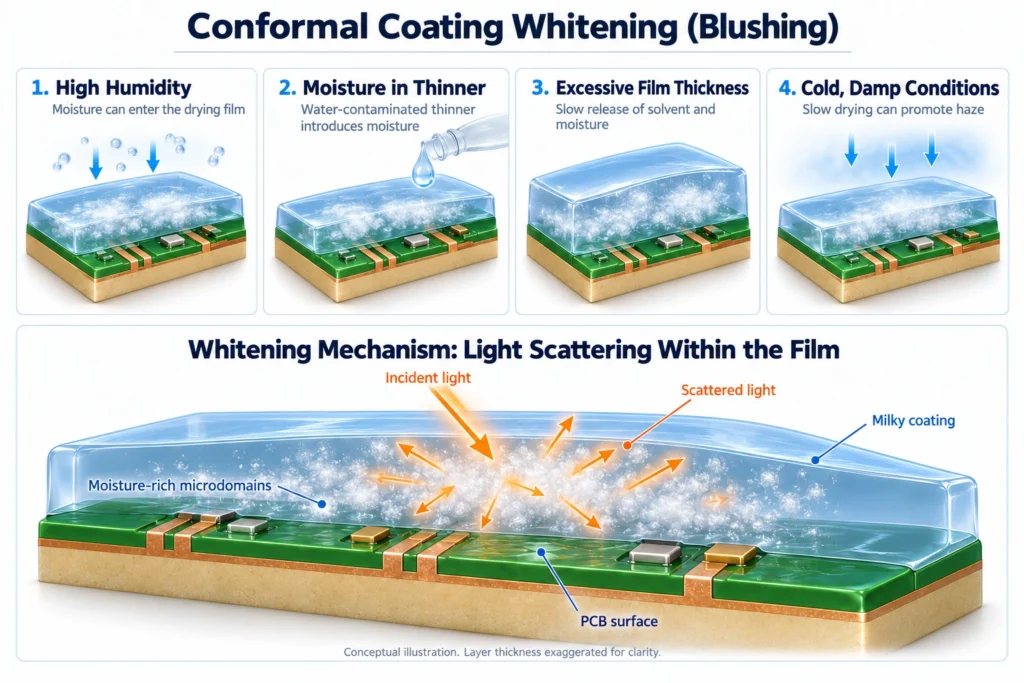
2. Blushing (Milky-White Coating)
Symptom: A solvent-based conformal coating dries to a milky-white, hazy appearance with reduced transparency.
Causes:
During coating and tack-free drying, ambient humidity above 65% causes moisture to condense on the coating surface as solvent evaporation drops the surface temperature sharply; fast-evaporating solvents under low-temperature, high-humidity conditions can also lock moisture into the coating.
Solution:
Keep coating environment humidity at 40%–60%; choose a thinner with a matching evaporation rate; without climate control, ensure at least good ventilation and dehumidification.
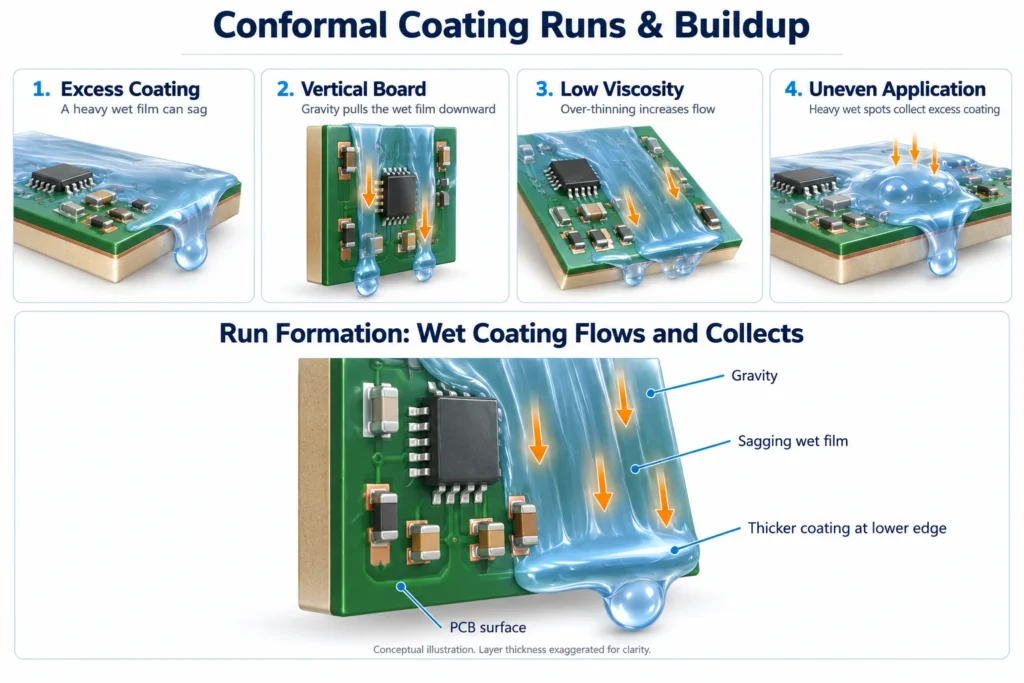
3. Runs and Buildup
Symptom: The coating flows under gravity and accumulates along board edges or on component sidewalls, resulting in uneven thickness.
Causes:
Incorrect selective coating equipment parameters are the main cause — spray pressure too high or nozzle travel too slow; coating viscosity too low; boards with many tall vertical components tend to accumulate coating at their bases.
Solution:
Measure the working viscosity first, then match nozzle height, spray pressure and travel speed to each other; run a parameter DOE before volume production.
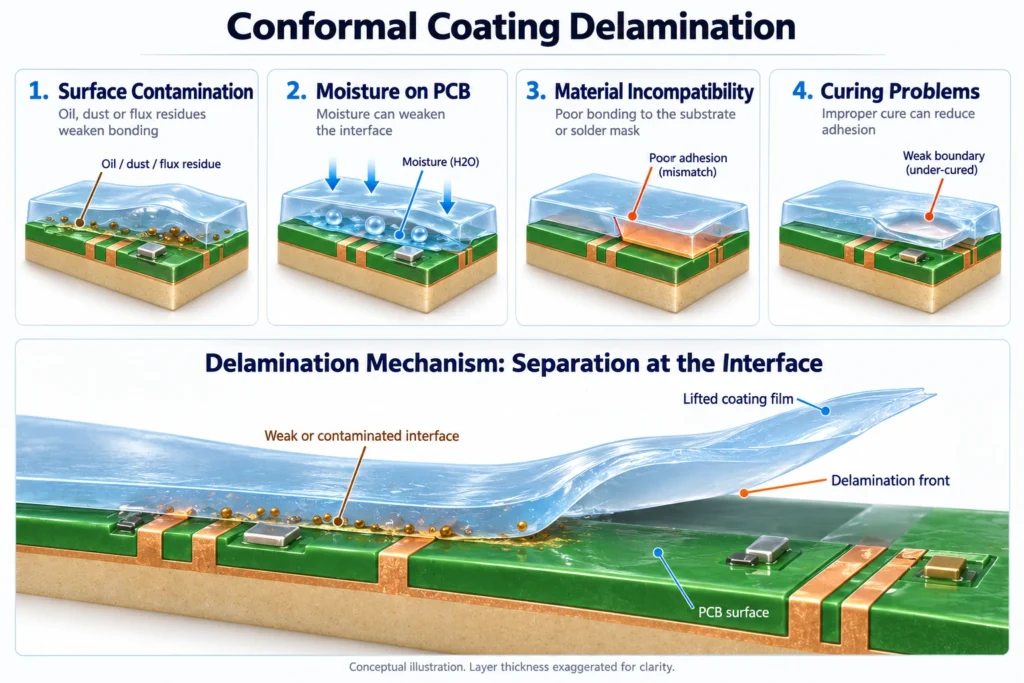
4. Poor Adhesion and Delamination
Symptom: The cured coating fails tape testing, or cracks and lifts after thermal cycling.
Causes:
Board surface contamination is the primary cause — flux residues, fingerprint oils and dust all reduce adhesion, and no-clean flux residues are especially difficult to wet due to their low surface tension; low substrate surface energy or insufficient curing can also cause delamination.
Solution:
Run a water-break test before coating (a uniform, non-retracting water film indicates acceptable cleanliness); follow the TDS curing parameters strictly and never shorten bake time.
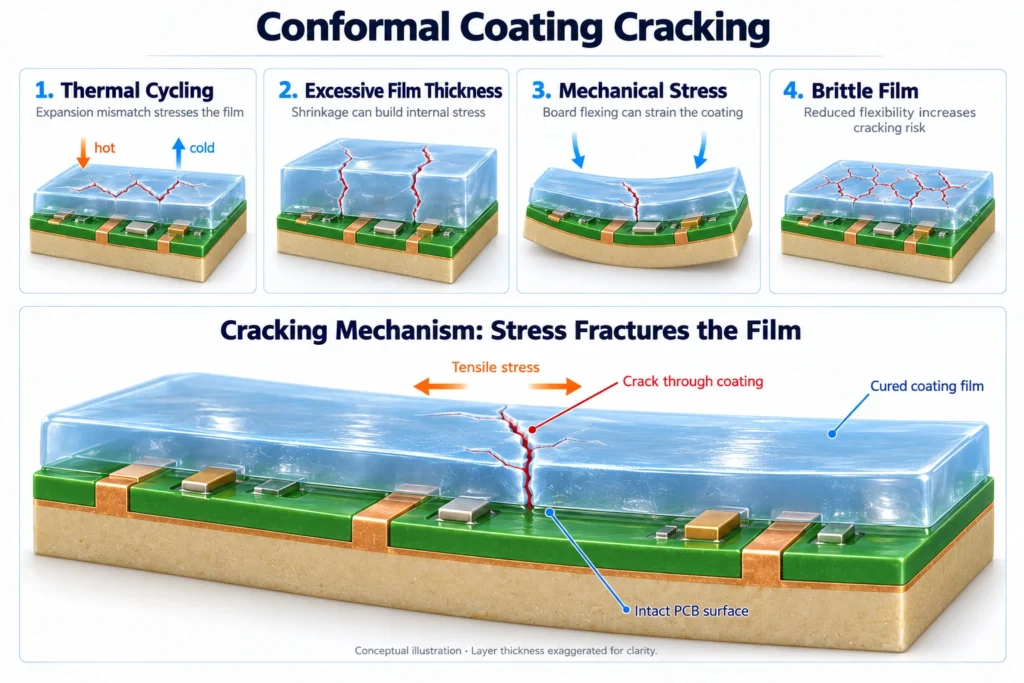
5. Cracks in the Coating
Symptom: Fine cracks appear on the coating surface after thermal cycling; in severe cases they extend to the components themselves.
Causes:
Excessive coating thickness builds up shrinkage stress and makes the coating brittle at low temperatures; a coating whose Tg is below the lower limit of the operating temperature cannot release thermal expansion stress; large ceramic capacitors and other low-CTE components create a large expansion mismatch with the coating, concentrating stress at the interface.
Solution:
Keep the coating thickness within the recommended range given in the TDS, and select a coating with low elastic modulus and high elongation at break for boards subject to wide temperature swings.
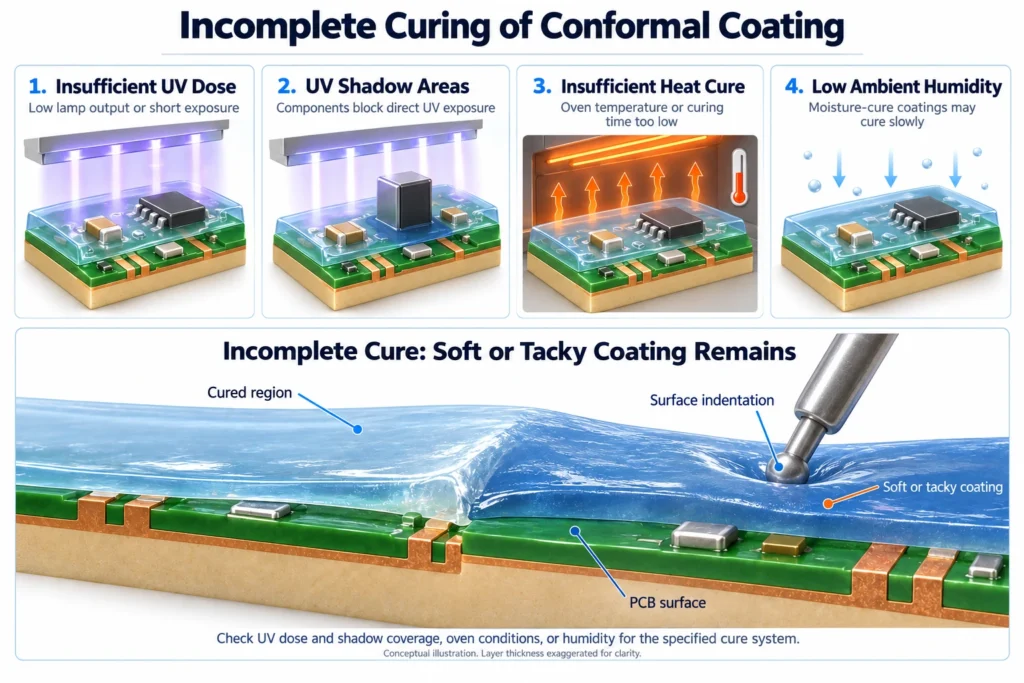
6. Incomplete Curing
Symptom: The coating feels tacky, shows marks when scratched with a fingernail, and fails to meet insulation requirements.
Causes:
For UV coatings — UV lamp power decay or insufficient exposure, leaving shadowed areas without enough UV energy; for heat-cure coatings — insufficient oven temperature or time; for moisture-cure coatings — ambient humidity too low.
Troubleshooting & solution:
Wipe the coating with an alcohol-dampened cotton swab — if the film comes off, curing is incomplete; for UV coatings, check the accumulated lamp hours and replace lamps that have exceeded their service life.
Defect Quick-Reference Table
| Defect | Typical Symptom | Main Root Cause | First Countermeasure |
|---|---|---|---|
| Bubbles | Blisters after curing, peeling | Wet board, coat too thick, temperature ramp too fast | Thorough drying + comparison board test |
| Blushing | Milky-white haze, loss of transparency | Humidity >65%, solvent evaporating too fast | Control humidity at 40%–60%, match thinner |
| Runs / buildup | Coating pooling at board edges and component sides, uneven thickness | Mismatched pressure / speed / viscosity | Measure viscosity + parameter DOE |
| Poor adhesion / delamination | Fails tape test, lifts after thermal cycling | Surface contamination, low surface energy, under-curing | Water-break test + cure per TDS |
| Cracks | Fine cracks after thermal cycling, extending to components | Too thick, Tg mismatch, CTE mismatch | Control thickness + choose high-elongation coating |
| Incomplete curing | Tacky, fingernail marks, insulation below spec | UV lamp power, insufficient baking, low humidity | Alcohol-wipe verification + adjust lamp power and bake temperature |
From Material to Process: Systematically Reducing Defect Rates
Material selection — processability matters as much as thermal and insulation performance:
· Acrylic conformal coatings: easy to apply and rework, suitable for low-volume, high-mix lines; average solvent resistance, and may soften under long-term damp heat.
· Polyurethane conformal coatings: strong adhesion and chemical resistance, suitable for automotive electronics and industrial control; longer curing time, and sensitive to board cleanliness.
· UV conformal coatings: second-level curing, suitable for high-volume lines; shadowed areas under components require a secondary cure mechanism.
Water-based conformal coatings: environmentally friendly with low VOC, suitable for lines with environmental requirements; drying conditions are stricter than solvent-based systems and demand tight temperature and humidity control.
Four process control essentials:
1. Pre-treatment: dry boards thoroughly after cleaning, and run an ionic contamination test before coating — keep it below 1.56 μg NaCl/cm² (IPC reference value);
2. Viscosity management: measure working viscosity at the start of every shift; adjust the thinning ratio when drift exceeds 10%;
3. Coating thickness: monitor with wet-film gauges or dry-film thickness meters — first-article confirmation plus batch sampling;
4. Curing profile: regularly verify oven temperature uniformity and UV lamp intensity decay; establish and validate SOPs.
Environment management: The ideal coating environment is 20–25°C and 40%–60% humidity; without climate control, ensure at least good exhaust ventilation, and avoid high-volume coating of solvent-based products on rainy days.
Conformal Coating Buying Guide FAQ
Q1: What is a conformal coating on a circuit board?
A conformal coating is a protective layer applied to PCBs, solder joints, components and metal surfaces. It conforms to complex geometries and helps products resist moisture, dust, mold, salt spray, chemical contamination and temperature change. It improves environmental adaptability and insulation reliability, but it cannot directly replace mechanical design or an enclosure IP rating.
Q2: How do I quickly choose a suitable Changxian New Material conformal coating?
Confirm four conditions first: your protection environment, application process, curing cycle and rework requirement. For conventional moisture, dust and sulfurization protection with flexible processing, evaluate acrylic systems M788-1 and M988. For higher moisture, chemical, salt spray and insulation requirements, evaluate polyurethane systems M78H-41 and M78H-86. For low odor, safety and environmental process, evaluate water-based polyurethane M888. For automation and high-volume cycle time, evaluate UV/moisture dual-cure M78-3068UV.
Q3: How do I conformal coat a circuit board?
The basic process is: clean and dry your PCB; mask connectors, contacts, test points and other no-coating areas; select brushing, dipping, spraying or selective coating; adjust viscosity and film thickness according to the TDS; complete drying or curing; inspect coverage, bubbles, pooling, missed areas and adhesion. Validate the process on your actual boards before mass production.
Q4: What is the difference between M788-1 and M988?
Both belong to the acrylic family. M788-1 is a one-component modified acrylic conformal coating featuring a transparent film, low odor, moisture, dust and sulfurization resistance, and fluorescent inspection. M988 is a silicone-modified acrylic conformal coating that supports brushing, dipping and spraying. It is especially suitable for processes using both silicone potting and conformal coating, helping improve interface drying problems caused by system incompatibility.
Q5: How do I choose between M78H-41 and M78H-86?
M78H-41 is more suitable for PCBs, electronic components and metal surfaces requiring a transparent hydrophobic film, high insulation resistance and sulfurization-resistance evaluation. M78H-86 is more suitable for power boards, industrial electronics and assemblies with higher salt spray and electrical performance requirements. It supports brushing, dipping and spraying, and its TDS reports no blistering, whitening, cracking or rust after 72 hours of neutral salt spray testing.
Q6: How long do conformal coatings take to dry?
Drying time depends on chemistry, film thickness, temperature, humidity, airflow and curing method. Acrylic and polyurethane systems may reach touch dryness in minutes to tens of minutes, but optimum performance usually takes longer to develop. Some TDS values are based on about seven days of room-temperature conditioning. UV systems can cure exposed areas quickly, but shadowed areas still need moisture-cure evaluation; do not judge by surface dryness alone.
Q7: How do I measure conformal coating thickness?
Common methods include wet film gauges, dry film thickness gauges, cross-section measurement, weight-based calculation, or establishing the relationship between spray parameters and film thickness on test coupons. Fluorescent inspection mainly checks coverage integrity and does not prove thickness compliance. Establish first-article confirmation and sampling inspection on your production boards or coupons.
Q8: Are conformal coatings waterproof?
Conformal coatings can improve moisture, mold, salt spray and insulation protection, but waterproof performance depends on product structure, coating coverage, film thickness, curing completeness and final testing. Use terms such as moisture protection or environmental protection on the page; do not directly claim waterproof or an IP rating.
Q9: How do I waterproof electronic circuits?
Waterproofing is a system-level task and cannot be achieved by conformal coating alone. It usually requires structural design, enclosure sealing, connector protection, potting, sealants, breathable vents, harness handling and finished-product testing. Conformal coating can be one protective layer, but the system should be selected according to your target environment and validated on your actual samples.
Q10: What is conformal coating dielectric strength?
Dielectric strength is usually expressed in kV/mm and reflects the electric field a material can withstand per unit thickness. A dielectric withstand voltage result such as greater than 1500 V is different and should not be used interchangeably. For example, the M988 TDS lists breakdown strength of at least 40 kV/mm, while M78-3068UV lists dielectric strength of 75 kV/mm. M78H-41, M78H-86 and M888 documents list dielectric withstand voltage greater than 1500 V.
Q11: Do conformal coatings protect components from ESD?
Conformal coatings are not the primary ESD protection measure. They can provide insulation and environmental protection, but they cannot replace grounding, ESD design, shielding, TVS devices, ESD workshop management or packaging and transportation controls. If a product has ESD requirements, evaluate them separately in circuit design, structural design and production management.
Q12: How do I remove conformal coatings from PCBs?
Removal depends on the chemistry. Acrylic systems are generally easier to rework; polyurethane and UV-cured systems are usually more difficult because of higher chemical resistance and crosslinking. Before mass production, confirm your removal method, cleaning-agent compatibility, local repair process and recoating adhesion. Do not assume that the application thinner can safely remove fully cured coating.
Q13: Can I request free samples and documents?
Yes. Free samples, TDS, MSDS, RoHS, REACH and UL documents are available by model. The relevant UL Product iQ file number for conformal coatings is E513343. Exact model coverage is subject to the latest documents and product markings.
Q14: What are the packaging and shelf life?
M788-1, M988, M78H-41, M78H-86 and M888 are commonly supplied in 4 L or 20 L packages; M78-3068UV is commonly supplied in 1 L or 4 L packages. Most models should be stored sealed, protected from light and kept in a cool place. Shelf life is typically six months. Exact packaging, storage temperature and shelf life are subject to the latest TDS.
Q15: Where can I buy conformal coatings? What information is needed for a quotation?
Contact Changxian New Material directly for samples, quotations and technical support. Please provide your PCB or assembly type, board dimensions, production capacity or annual usage, application method, target film thickness, curing equipment, operating environment, reliability requirements, environmental requirements, destination country, expected delivery time, and whether samples, TDS, MSDS, RoHS, REACH or UL documents are required. The more complete your information, the more accurate our selection and recommendations.
Advantages of Changxian New Material Conformal Coatings
· Improved device reliability: protects your PCBs and critical components in humid, salty, dusty and chemically contaminated environments.
· Lower failure rates: reduces early failures of your products caused by corrosion, leakage, short circuits and insulation resistance decline.
· Longer product life: helps reduce your after-sales repair, warranty cost and field maintenance pressure.
· Higher production efficiency: supports your brush, dip, spray, selective coating and UV fast-curing processes.
· Suitable for harsh environments: covers your high and low temperature, damp heat, salt spray and thermal shock requirements.
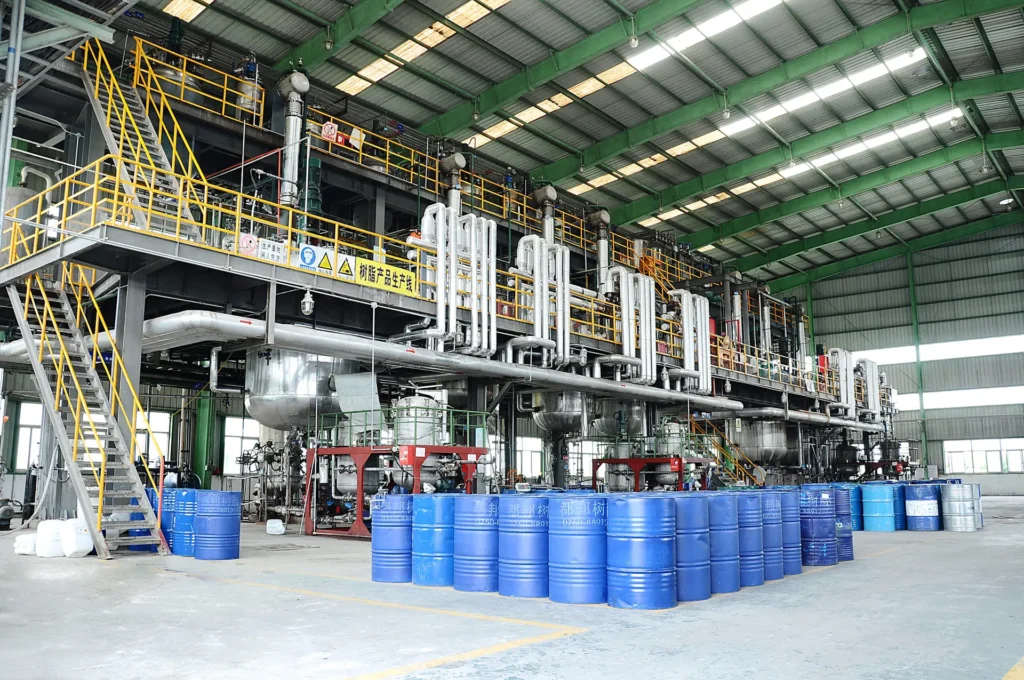
· China factory advantage: a 40,000 m² manufacturing base, mature electronic chemicals supply chain and export support capability give you stable and efficient delivery.
· Factory-direct cost advantage: in-house resin synthesis, 20,000-ton annual capacity and direct supply help you control purchasing cost while maintaining quality.
· Compliance support: UL Product iQ file E513343; RoHS and REACH documents are available by model for your validation.
· Flexible selection: multiple chemistries, free samples and selection support from our engineers help you validate and introduce products faster.
Whether your products face outdoor humidity, high salt spray, automotive electronics, power supplies or industrial control, Changxian New Material can help you choose a suitable conformal coating from four perspectives: material system, process window, China manufacturing supply chain and compliance documentation.
Final CTA
Not sure which conformal coating fits your PCB and production line? Send us your board type, application method, target film thickness, curing conditions, environmental requirements and compliance documents needed. Our engineers can help you evaluate and select the right conformal coating for your application., and provide free samples, TDS, MSDS, RoHS, REACH and UL documents for validation.
Related Products