Electrical Varnish: 5 Resin Systems and Their Processing Differences
Abstract: Electrical varnish selection should not be based on dielectric strength or thermal class alone. A comparison of five Changxian TDS documents—for E57A, E962, E57-81H, E57-89H, and E962-788—shows that these materials use alkyd-amino, modified polyester, modified unsaturated polyester, solventless epoxy-polyester, and modified acrylic systems, respectively. Their active or non-volatile content, dilution requirements, drying conditions, and applicable impregnation processes differ. You should first confirm whether the resin system is compatible with your production process and then compare the relevant performance data.
Why Electrical Varnish Should Not Be Compared by Dielectric Strength Alone
Electrical varnish dielectric strength is one indicator of insulation performance, but it cannot determine whether a material is suitable for your winding and production process.
Among the five products compared in this guide, E57A and E962-788 both have a specified dielectric strength of at least 60 kV/mm under normal conditions. However, E57A uses an alkyd-amino baking system, while E962-788 uses a modified acrylic system. Their non-volatile content, designated thinners, and drying conditions are different.
E57-89H has a specified electric strength of at least 24 MV/m under normal conditions. Although this value is lower than the figures stated for the two products above, E57-89H uses a solventless epoxy-polyester system with 100% active ingredients. Its TDS also specifies vacuum impregnation and trickle impregnation processes. Its processing position is therefore different from that of materials whose application involves solvent evaporation, and a single dielectric strength figure cannot establish which material is more suitable.
In addition, specimen condition, curing conditions, and test methods may differ between TDS documents. Material data should be compared item by item only when the relevant test conditions are comparable.
Overview of the Five Resin Systems and Their Processing Methods
The following table summarizes information directly related to resin chemistry and processing in the five TDS documents. The performance data were not obtained under identical test conditions. This table is intended to identify system differences rather than establish a simple performance ranking.
| Model | Resin System | Composition or Dilution Information | Thermal Class | Drying or Curing Conditions Stated in the TDS | Main Processing Information |
| E57A | Alkyd-amino | Non-volatile content: 45–55%; designated X-7 Series thinner | B–F | 110°C: 3–5 h; 120°C: 2–4 h | Baking system; dilution ratio and baking time must be determined through testing |
| E962 | Modified polyester | Non-volatile content: 40.0 ± 2.0%; designated X-7 Series thinner | B | Air-drying; surface dry at 25°C in 10–15 min; through-dry at 80°C in 75 min | Surface drying and through-drying must be distinguished for both air-drying and heated drying |
| E57-81H | Modified unsaturated polyester | One-component solventless system containing a reactive thinner | H | Reference baking conditions: 145–150°C for 4–8 h | Suitable for vacuum and atmospheric-pressure impregnation |
| E57-89H | Solventless epoxy-polyester | 100% active ingredients; formulated with an accelerator and a curing agent | H–C | Reference process: 135–150°C for 2–4 h, or until winding resistance stabilizes | Vacuum impregnation and trickle impregnation processes are specified in the TDS |
| E962-788 | Modified acrylic | Glycol-ether-based system; non-volatile content: 37 ± 3%; designated X-08 thinner | B | 90°C: 3–5 h; 100°C: 2–4 h | Dilution ratio and drying time must be determined through testing for the specific application |
Alkyd-Amino System: Baking Processing with E57A
E57A is a baking insulating varnish based on an alkyd-amino resin system. Its TDS specifies a thermal class of B–F and a dielectric strength of at least 60 kV/mm under normal conditions.
Its processing approach combines a designated thinner with a baking process. The non-volatile content is 45–55%, and the TDS specifies the X-7 Series thinner. You should not treat the viscosity of the supplied varnish as the application viscosity for every workpiece. The dilution ratio and baking time should be determined through testing according to the shape, dimensions, and requirements of your product.
The TDS provides two through-drying conditions:
- 3–5 hours at 110°C;
- 2–4 hours at 120°C.
These figures are material-level TDS indicators and should not replace the production curing schedule for an actual workpiece. Changes in winding size, varnish pickup, and oven conditions require sample verification to confirm whether the interior has dried adequately.
The E57A TDS also states that the varnish may absorb moisture and turn whitish under high-humidity conditions, without affecting product performance after baking. This statement is documented in the product TDS, but it does not eliminate the need to inspect the actual film and winding condition.
Modified Polyester System: Air-Drying and Heated Drying with E962
E962 uses a modified polyester resin system. Its TDS explicitly identifies it as air-drying and assigns it a Class B thermal rating.
Its air-drying characteristic distinguishes it from E57A, which requires a baking process. However, air-drying does not mean that no curing takes place, and surface drying does not mean through-drying. The E962 TDS provides the following separate drying values:
| Drying Item | Test Condition | TDS Specification |
| Surface-drying time | 25°C | 10–15 min |
| Surface-drying time | 80°C | 5–10 min |
| Through-drying time | 80°C | 75 min |
These values show why drying speed must be discussed together with the temperature and whether the reported state is surface dry or through dry. The 10–15-minute surface-drying figure should not be used as evidence that a workpiece is ready for energization or every subsequent production step.
E962 has a non-volatile content of 40.0 ± 2.0% and uses the X-7 Series designated thinner. The dilution ratio and processing conditions should still be determined according to the shape, size, and requirements of the workpiece. The TDS recommends a baking temperature not exceeding 100°C, but this does not mean that one temperature will produce the same cured condition in every workpiece.
Modified Unsaturated Polyester System: Reactive Dilution and Impregnation with E57-81H
E57-81H is formulated from a modified heat-resistant unsaturated polyester resin, a reactive thinner, a stabilizer, and additives. It is a one-component, solventless, Class H polyester insulating resin.
The reactive thinner in this system should not be treated as the same processing concept as the designated thinners used with E57A and E962. When comparing materials, you need to review the system description in each TDS rather than assume that every reference to a thinner has the same meaning.
The E57-81H TDS specifies:
- Breakdown strength of at least 22 MV/m under normal conditions;
- Breakdown strength of at least 20 MV/m after 24 hours of water immersion;
- Excellent refrigerant resistance after 96 hours;
- Suitability for vacuum and atmospheric-pressure impregnation.
Its reference process is to preheat the workpiece at 110–120°C for 2–4 hours, impregnate at 40–50°C for 15–30 minutes, drain for 20–40 minutes, and then bake at 145–150°C for 4–8 hours. For more demanding applications, the TDS also provides reference options of extending the baking time or baking at 160°C for 8 hours.
These parameters are reference conditions for E57-81H. They should not be applied directly to other polyester systems or other insulating resin models.
Solventless Epoxy-Polyester System: Active Content and Curing Requirements of E57-89H
E57-89H uses a solventless epoxy-polyester system and should not be described as a pure epoxy insulating varnish. It is formulated with a modified heat-resistant solventless epoxy-polyester resin, an accelerator, and a curing agent. Its TDS specifies 100% active ingredients and a thermal classification of H–C.
Compared with materials whose processing requires close attention to solvent evaporation and surface drying, the processing focus of E57-89H is more closely associated with impregnation, gelation, and heat curing.
| Property | TDS Specification |
| Electric strength under normal conditions | ≥24 MV/m |
| Bond strength under normal conditions | ≥140 N |
| Bond strength at 180°C | ≥50 N |
| Thermal conductivity | ≥0.4 W/m·K |
| Gel time | 5–15 min at 120 ± 2°C |
| Curing time | TDS process reference: 2–4 h at 135–150°C, or until winding resistance stabilizes |
A 100% active ingredient statement does not mean that baking is unnecessary. Likewise, an H–C material classification does not demonstrate that the complete electrical insulation system of the equipment has received the same classification. Thermal conductivity also cannot be converted directly into a specified reduction in complete-motor temperature rise.
The E57-89H TDS specifies vacuum impregnation and trickle impregnation. Its vacuum impregnation reference conditions include a vacuum of 0.08 MPa, immersion for 30 minutes, draining for more than 30 minutes, and staged baking. For trickle impregnation, preheating the workpiece to approximately 50°C is recommended. These conditions should be confirmed through samples using the actual workpiece design; they are not universal production settings for every stator or winding.
Modified Acrylic System: Glycol-Ether-Based Composition and Drying Conditions of E962-788
E962-788 is a modified acrylic insulating varnish using a glycol-ether-based system. Its TDS states that it contains no benzene, toluene, or xylene and complies with RoHS and REACH requirements, as well as halogen-free requirements.
The product has a Class B thermal rating, a dielectric strength of at least 60 kV/mm under normal conditions, a non-volatile content of 37 ± 3%, and an X-08 designated thinner. Its TDS provides two drying conditions:
- 3–5 hours at 90°C;
- 2–4 hours at 100°C.
Although “fast drying” is listed among its product characteristics, E962-788 should not therefore be classified as having the same air-drying process as E962. The two products differ in resin chemistry, designated thinner, and TDS drying conditions, so they require separate evaluation.
The E962-788 TDS also describes low-temperature resistance and adhesion characteristics. These qualitative statements should not be expanded into quantitative performance claims that are not supported by specified test conditions.
How to Turn the Five Systems into Your Process Validation Plan
When selecting an electrical varnish, you can use the following sequence to convert resin-system differences into practical validation items.
1. Review the Material Composition First
Confirm whether the TDS describes an alkyd-amino, modified polyester, unsaturated polyester, epoxy-polyester, or modified acrylic system. Do not determine the resin system from general descriptions such as environmentally friendly, heat-resistant, or fast-drying.
2. Review Active Content and Dilution Information Separately
Record non-volatile content, reactive thinners, and designated thinners as separate items. Solventless products should also be handled according to their own TDS and application requirements. Do not transfer a dilution ratio from another model without verification.
3. Distinguish Surface Drying, Through-Drying, and Curing
Air-drying, heated drying, and baking cure are not interchangeable descriptions. Your validation record should identify the temperature, time, workpiece condition, and acceptance criterion rather than state only that the surface feels dry.
4. Confirm Whether the Impregnation Process Is Supported by the TDS
The E57-81H TDS specifies vacuum and atmospheric-pressure impregnation, while the E57-89H TDS specifies vacuum impregnation and trickle impregnation. Whether another model can use the same process should be established from its own TDS and test results rather than inferred from these two products.
5. Complete Final Validation with Actual Workpieces
Laboratory data help narrow the candidate range, while actual-workpiece validation confirms suitability. Retain records of the material batch, application viscosity, impregnation method, draining time, curing schedule, and inspection results.
Test Conditions That Must Be Aligned When Comparing Different TDS Documents
The five TDS documents show that even properties with the same name may use different test conditions and units.
| Comparison Item | Information to Review | Actual Differences in These TDS Documents |
| Viscosity | Temperature, viscosity cup, and test method | Most models use a Tu-4 cup at 25°C; E57-81H uses a Tu-4 viscometer at 23 ± 2°C |
| Non-volatile content | Heating temperature and duration | E57A uses 120°C for 2 h; E962 and E962-788 use 105°C for 3 h |
| Electric or dielectric strength | Specimen condition, curing conditions, and units | Curing and test conditions differ by model; 1 kV/mm and 1 MV/m are numerically equivalent |
| Volume resistivity | Normal condition, post-immersion or elevated-temperature condition, and units | Different models use Ω·m or Ω·cm; 1 Ω·m = 100 Ω·cm |
| Drying or curing | Surface drying, through-drying, gelation, or production curing schedule | These indicators represent different stages and cannot be substituted for one another |
If these conditions are not aligned first, a more complete-looking data table can produce a less reliable comparison.
FAQ
Is an unsaturated polyester or epoxy-polyester system better?
There is no universal answer independent of the application and process conditions. E57-81H and E57-89H differ in composition, thermal classification, bonding performance, reference processes, and TDS test items. You should identify candidate materials according to winding design, impregnation method, and curing conditions before comparing data obtained under identical or similar conditions.
Does a solventless insulating varnish never require a thinner?
That cannot be assumed. A solventless system and an application-viscosity adjustment are separate issues. E57-81H contains a reactive thinner, while E57-89H is specified as containing 100% active ingredients. Whether viscosity adjustment is required should be determined from the specific TDS, workpiece requirements, and technical evaluation.
Can an air-drying product directly replace a baking product?
No direct replacement should be assumed. Changing the material can change the resin system, drying mechanism, and production conditions at the same time. Even when two products have the same thermal class, impregnation, drying, curing, and final winding performance require renewed validation.
Can the five products be ranked by dielectric strength under normal conditions?
No. Specimen condition and curing conditions are not identical across the TDS documents. Dielectric strength also does not describe viscosity, active content, impregnation requirements, or production curing conditions. It should be treated as one part of a broader evaluation.
Can viscosity values from different TDS documents be compared directly?
The temperature, viscosity cup, and test method must first be reviewed. Even when the same Tu-4 cup is used, different test temperatures can affect the comparison. For production, you should also record the working-viscosity measurement rather than compare only the supplied-varnish specification.
Conclusion
Electrical varnish resin chemistry determines which comparison items should come first. There is no universal ranking among alkyd-amino, modified polyester, modified unsaturated polyester, solventless epoxy-polyester, and modified acrylic systems without considering process conditions.
A more reliable evaluation sequence is to review the resin system and active content, confirm dilution, impregnation, and curing requirements, compare performance data obtained under comparable test conditions, and then complete validation with actual workpieces.
If you provide your current resin system, winding type, impregnation method, and curing conditions, our engineers can help you identify candidate Changxian models, relevant TDS documents, and sample-validation items.
About Changxian
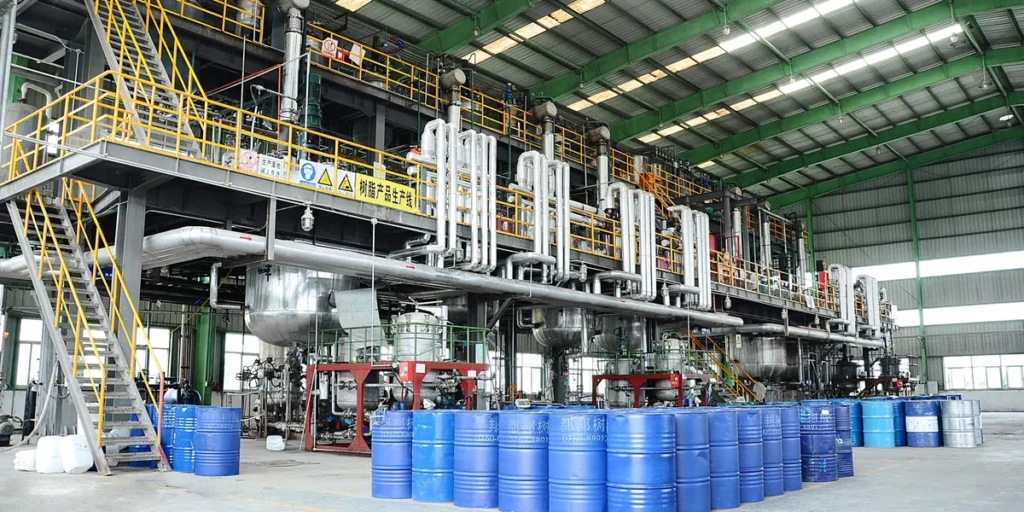
Zhuhai Changxian New Material Technology Co., Ltd. has specialized in electronic chemicals for more than 30 years. We are listed on China’s NEEQ under stock code 831323 and recognized as a national-level specialized and innovative “Little Giant” enterprise. Our approximately 40,000 m² production base in Zhuhai’s Gaolan Port area supports in-house resin synthesis. Our management systems include ISO 9001, ISO 14001, ISO 45001, and IATF 16949. We also hold relevant UL files for insulating varnishes and conformal coatings; coverage for specific models is subject to the applicable certificates.
Changxian’s position is straightforward: performance benchmarked item by item against international brands, with factory-direct pricing. You can contact our engineers for TDS documents, selection comparisons, and free sample support for evaluation under your actual application and process conditions.
TDS Sources
- E57A Baking Insulating Varnish Product Instruction
- E962 Insulating Varnish Product Instruction
- E57-81H Environmentally Friendly Heat-Resistant Modified Unsaturated Polyester Resin Product Instruction
- E57-89H Environmentally Friendly Solventless Insulating Varnish Product Instruction
- E962-788 Environmentally Friendly Insulating Varnish Product Instruction
Reference standard for thermal classification:IEC 60085:2007 — Electrical insulation: Thermal evaluation and designation
Contact us
Not sure which grade fits your parts and line?
Send Changxian New Material your part type (motor / transformer / coil / PCB), thermal class requirement, impregnation process (atmospheric / vacuum / VPI), baking conditions, production tempo and compliance requirements.
Our engineers can help you pick the right varnish for electric motors, transformers or coils — with impregnation parameter confirmation and compatibility verification — and provide samples, TDS, MSDS, RoHS, REACH, halogen-free and VOC documents for your qualification.