
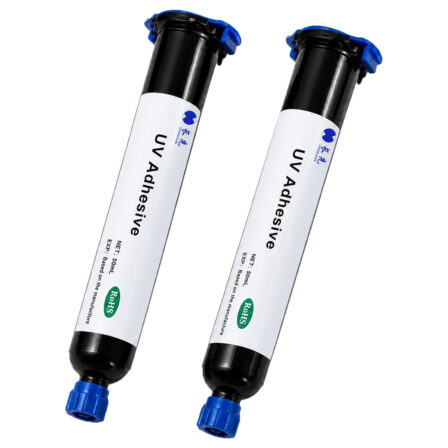

CXUV-0312A UV Adhesive for Plastic & Electronic Bonding
CXUV-0312A is a single-component, thixotropic UV adhesive based on urethane acrylate for electronic component fixation, wire harness reinforcement, and plastic bonding. Designed for automated dispensing, it cures under suitable UV or visible light to form a tough bond with impact and vibration resistance. The TDS reports shear strengths above 6 MPa for PC/PC and above 5 MPa for PVC/PVC.
- Description
- Technical Data
- FAQ
Description
Product Overview:
CXUV-0312A is a light-curable adhesive developed for bonding and sealing applications in electronic assembly. Its urethane acrylate formulation combines thixotropic dispensing behavior with adhesion to selected plastics and metals.
The thixotropic character helps control adhesive placement during machine dispensing, making it relevant to component fixation and localized reinforcement. After curing, the adhesive forms a tough bonding layer designed to withstand impact and vibration.
For plastic assembly, CXUV-0312A provides documented bonding performance on polycarbonate and polyvinyl chloride. The reports PC-to-PC shear strength above 6 MPa and PVC-to-PVC shear strength above 5 MPa. Metal is also listed as a compatible substrate category, although metal-specific bond strengths are not provided.
Recommended curing light sources: 365 nm or 395 nm UV LED area lights. Successful curing requires light of a suitable wavelength to reach the adhesive layer. Joint geometry, substrate transmission, bond-line thickness, and lamp conditions must therefore be evaluated together.
Key Features and Benefits:
· Single-Component Formulation: Simplifies preparation without mixing separate resin and hardener components.
· Thixotropic Dispensing Behavior: Supports controlled adhesive placement for automated dispensing and localized bonding.
· Rapid Light-Activated Curing: Designed for short curing cycles under suitable UV or visible-light exposure, subject to validation of the complete bond line.
· Documented PC Bonding Performance: Reports shear strength of >6 MPa for PC/PC joints under the stated test method.
· Documented PVC Bonding Performance: Reports shear strength of >5 MPa for PVC/PVC joints.
· Tough Cured Bond: Impact and vibration resistance, supporting evaluation for electronic assemblies exposed to mechanical disturbance.
· Multiple Substrate Options: Lists PC, PVC, and metal as suitable material categories, with compatibility testing required for the actual substrate grade and surface finish.
· Electrical Properties for Electronics Evaluation: Reports dielectric strength of 20 kV/mm and volume resistivity of 1.1 × 10¹³ Ω·cm.
· Defined Cured Hardness: A reported Shore D hardness of 58 ± 3 provides a reference for evaluating the mechanical characteristics of the cured adhesive.
Typical Applications:
CXUV-0312A UV adhesive is intended for:
· Electronic Component Fixation: Localized bonding to hold compatible components in position.
· Wire Harness Reinforcement: Reinforcement of selected harness locations, subject to compatibility with the wire insulation and assembly design.
· Polycarbonate Bonding: PC-to-PC joints with a suitable light path to the adhesive.
· PVC Bonding: PVC-to-PVC joints using validated substrate grades and curing conditions.
· Plastic and Metal Electronic Assemblies: Bonding or sealing where suitable curing light can reach the adhesive layer.
· Automated Adhesive Dispensing: Production processes requiring controlled adhesive placement and light-activated curing.
Ensure UV light can reach the adhesive layer. Confirm suitability before use in fully enclosed, opaque joints, including many metal-to-metal assemblies.
Applicable Materials:
· Polycarbonate (PC)
· Polyvinyl chloride (PVC)
· Metal
Pre-Cure Properties:
| Item | Test Method | Reference Value |
| Base Resin | Per composition | Polyurethane acrylate |
| Appearance | Visual | Amber transparent liquid |
| Viscosity (mPa·s @25℃) | GB/T 2794-2022 | 10000±1500 |
| Specific Gravity (@25℃) | GB/T 13354-1992 | 1.17 |
| Refractive Index (@25℃) | GB/T 6488-2022 | 1.48 |
Curing Conditions:
| Recommended Condition | 365nm UVLED Area Source | 395nm UVLED Area Source |
| Intensity (mW/cm² ) ) | 800 | 1500 |
| Curing Time (s) | 10 | 5 |
| Curing Energy (mJ/cm)²) | 4000 | 2000 |
Curing note: curing speed varies with UV lamp intensity, distance, spectral
distribution, exposure time and substrate light transmittance. Energy is measured
with dedicated meters: M120 tester for mercury lamps; LS128 LED energy meter for LEDs.
Post-Cure Properties:
| Item | Test Method | Value |
| Hardness (Shore D) | GB/T 2411-2008 | 58±3 |
| Water Absorption (100℃ 2h, %) | GB/T 1034-2008 | <4 |
| Shear Strength (MPa, PC/PC) | GB/T 7124-2008 | >6 |
| Shear Strength (MPa, PVC/PVC) | GB/T 7124-2008 | >5 |
Electrical Properties:
| Item | Test Method | Value |
| Dielectric Constant (1MHz) | GB/T1409-2006 | 2.6 |
| Dissipation Factor (1MHz) | GB/T1409-2006 | 0.03 |
| Dielectric Strength (kV/mm) | GB/T1408.1-1999 | 20 |
| Surface Resistivity (Ω) | GB/T1410-2006 | 1.9 x 10¹³ |
| Volume Resistivity (Ω·cm) | GB/T1410-2006 | 1.1*1013 |
Technical Notes:
· Viscosity is dynamic viscosity in mPa·s, not cup flow time.
· The refractive index is listed under uncured properties and should not be presented as a cured optical specification.
· The dielectric dissipation factor is dimensionless.
· PC/PC and PVC/PVC results apply to the tested substrate combinations; they do not establish bond strength on all plastics or metals.
Application Guidance:
· Surface Preparation
Clean bonding or sealing surfaces to remove oil, grease, dust, and other contaminants. Confirm that the cleaning process is compatible with the actual plastic grade, metal finish, and surrounding components.
Allow cleaned surfaces to dry before dispensing.
· Dispensing and Assembly
Dispense a controlled amount of adhesive using equipment suited to its viscosity and thixotropic behavior. Establish bead size, bond-line thickness, and assembly position through trials.
Arrange the joint so that suitable curing light reaches the entire adhesive layer. Evaluate transmission through the actual substrate, including its color, thickness, additives, and surface treatments.
· UV LED Curing References
Use the following values as preliminary references. Confirm the irradiance, exposure time and energy dose are consistent before setting production curing conditions.
| Parameter | 365 nm UV LED Area Source | 395 nm UV LED Area Source |
|---|---|---|
| Listed irradiance | 800 mW/cm² | 1,500 mW/cm² |
| Listed curing time | 10 s | 5 s |
| Listed exposure energy | 4,000 mJ/cm² | 2,000 mJ/cm² |
Confirm the validated wavelength, irradiance at the adhesive plane, exposure time, and measured dose with our technical team.
Curing speed depends on lamp intensity, source distance, spectral output, exposure time, substrate transmission, and adhesive thickness. Measure exposure with an instrument appropriate for the light source and validate cure on the actual assembly.
Do not assume that initial fixation means the joint has reached its final properties.
· Temperature-Sensitive Components
Monitor assembly temperature during light exposure. Where necessary, use suitable cooling for temperature-sensitive materials, as advised in the TDS.
Allow bonded parts to cool to room temperature before applying mechanical loads.
· Light and Moisture Control
Protect the adhesive from sunlight, UV light, and unintended artificial-light exposure during storage and dispensing.
The TDS also identifies sensitivity to atmospheric moisture. Use opened material promptly and prevent contamination. This moisture sensitivity is not a documented shadow-curing mechanism.
Do not return unused dispensed adhesive to the original container.
· Cleanup and Rework
IPA and MEK as examples of solvents for removing uncured adhesive. Check substrate compatibility before use and follow the solvent’s handling requirements.
A removal procedure for fully cured adhesive is not provided. Confirm rework options before approving the material for repair-sensitive assemblies.
Precautions:
· This product is light-sensitive; during storage and operation, minimize exposure to daylight, UV and other artificial light sources;
· Sensitive to air moisture; use soon after opening to avoid natural curing;
· Clean the surfaces to be sealed or bonded before use, removing impurities, oil and other contaminants to achieve the expected sealing and bonding effect;
· Curing: irradiate with UV/visible light of suitable wavelength reaching the adhesive; time depends on lamp intensity and distance, typically 6x fixture time;
· When bonding temperature-sensitive materials, cool the material before use;
· Uncured adhesive can be cleaned with organic solvents such as IPA or MEK;
· Bonded parts must cool to room temperature before bearing loads.
This product is mildly irritating to eyes and skin. If splashed into eyes, rinse immediately with plenty of water; if on skin, wash with soap. Seek medical advice in serious cases. Keep away from children. To avoid contaminating unused adhesive, do not pour leftover adhesive back into the original bottle.
Packaging, Storage/Transport & Shelf Life:
· 30 g/pc, 225 pcs/carton
· 50 g/pc, 100 pcs/carton
Storage & Transport:
· Store in a dark, cool, dry place, 8-28℃ .
· Shelf life: 12 months.
Please Note:
· As our products are continuously improved, the information in this manual may be updated from time to time without prior notice. Please feel free to contact our sales team for the latest version.
· Do not mix this product with other products.
· We strictly control product quality and supply products in accordance with applicable product standards. Custom products are supplied according to mutually agreed specifications. Application conditions vary and are beyond our control. You should therefore test and evaluate the product and the information provided in this manual, together with the recommended application procedures, to determine suitability for your specific use.
Frequently Asked Questions About CXUV-0312A UV Adhesive
1. What is CXUV-0312A UV adhesive used for?
CXUV-0312A is a single-component urethane acrylate adhesive designed for bonding, sealing, and localized reinforcement in electronic assemblies.
Typical applications include electronic component fixation, wire harness reinforcement, and bonding of compatible polycarbonate (PC), polyvinyl chloride (PVC), and metal surfaces. The joint must allow suitable curing light to reach the adhesive layer.
2. What bond strength does CXUV-0312A provide on PC and PVC?
The TDS reports shear strength greater than 6 MPa for PC-to-PC joints and greater than 5 MPa for PVC-to-PVC joints under the stated test method.
These results apply to the tested substrate combinations. Validate the actual plastic grade, surface preparation, bond-line thickness, and curing conditions before production use.
3. Can CXUV-0312A bond metal components?
Metal is listed as a compatible substrate category, but the supplied TDS does not provide metal-specific bond-strength values.
Suitable curing light must reach the adhesive. Fully enclosed metal-to-metal joints can block that light, so confirm joint suitability with our engineers and test the actual metal finish and assembly geometry.
4. Will CXUV-0312A cure in shadowed areas?
The supplied TDS does not specify a secondary curing mechanism for adhesive that cannot receive light.
Arrange the joint so suitable light reaches the entire bond line. Moisture sensitivity during storage should not be interpreted as a validated moisture-curing mechanism for shadowed areas.
5. Which UV wavelengths can be used to cure CXUV-0312A?
The TDS provides curing references for 365 nm and 395 nm UV LED area sources.
Select and validate the lamp using the actual substrate transmission, adhesive thickness, source distance, and exposure conditions. Substrate color, thickness, additives, and surface treatments can affect how much curing light reaches the adhesive.
6. How long does CXUV-0312A take to cure?
CXUV-0312A is designed for short light-curing cycles, but the supplied irradiance, exposure-time, and energy values require clarification before use as a production recipe.
Confirm the wavelength, irradiance at the adhesive plane, exposure time, and measured dose with our technical team. Validate complete curing on the actual joint rather than treating initial fixation as full bond-strength development.
7. Is CXUV-0312A suitable for automated dispensing?
Yes. Its thixotropic behavior supports controlled adhesive placement for automated dispensing and localized component bonding.
The reported dynamic viscosity is 10,000 ± 1,500 mPa·s at 25°C. Establish nozzle selection, dispensing pressure, bead size, and bond-line thickness through equipment trials, and protect the material from unintended light exposure.
8. Does CXUV-0312A require a separate hardener?
No. CXUV-0312A is supplied as a single-component adhesive and does not require a separate resin-to-hardener mixing step.
Clean and dry the bonding surfaces, dispense the required amount, position the components, and cure using a validated light-exposure process.
9. What mechanical properties does cured CXUV-0312A provide?
The TDS describes the cured adhesive as tough and resistant to impact and vibration. Its reported hardness is Shore D 58 ± 3.
These properties support evaluation for component fixation and localized reinforcement. Actual joint durability depends on substrate compatibility, bond geometry, complete curing, and service loads.
10. What electrical properties does CXUV-0312A provide?
The TDS reports dielectric strength of 20 kV/mm and volume resistivity of 1.1 × 10¹³ Ω·cm. It also reports a dielectric constant of 2.6 and a dissipation factor of 0.03 at 1 MHz.
These cured-material properties support electronics application testing but do not independently establish the allowable operating voltage of a finished assembly.
11. Is CXUV-0312A waterproof or suitable for high-temperature service?
The TDS reports water absorption below 4% after the specified two-hour test at 100°C. This does not establish waterproof sealing, continuous immersion suitability, or a service-temperature rating.
The supplied documents do not specify a continuous operating-temperature range. Request application-specific data for the intended temperature, moisture exposure, and sealing requirements.
12. How should surfaces be prepared before bonding?
Remove oil, grease, dust, and other contaminants, and allow the surfaces to dry before dispensing.
Confirm that the cleaning method is compatible with the actual plastic grade, metal finish, and surrounding components. Evaluate adhesion and light transmission using representative production parts.
13. Can CXUV-0312A be used with temperature-sensitive components?
CXUV-0312A can be evaluated for temperature-sensitive assemblies, provided the temperature reached during light exposure remains acceptable for the materials.
Monitor assembly temperature and use suitable cooling where needed. Allow bonded parts to cool to room temperature before applying mechanical loads.
14. How can uncured or cured CXUV-0312A be removed?
The TDS identifies IPA and MEK as examples of solvents for removing uncured adhesive. Verify compatibility with the substrate and follow the applicable handling instructions before use.
A removal procedure for fully cured adhesive is not provided. Confirm a suitable rework method before selecting the product for repair-sensitive assemblies.
15. What safety and compliance documents are available for CXUV-0312A?
The product’s Technical Data section lists an MSDS, RoHS documentation, REACH documentation, and California Proposition 65 documentation.
16. How is CXUV-0312A packaged and stored?
CXUV-0312A is available in 30 g units, with 225 units per carton, and 50 g units, with 100 units per carton.
The stated shelf life is 12 months when stored under the specified conditions in a dark, cool, dry location at 8–28°C. Protect it from light and atmospheric moisture, use opened material promptly, and do not return dispensed adhesive to the original container.
17. What information should I provide when requesting a CXUV-0312A quotation?
Include the substrates and grades, joint geometry, bond-line thickness, dispensing method, and available UV equipment. Describe any impact, vibration, electrical, moisture, or temperature requirements.
For pricing and delivery, provide the required quantity, preferred pack size, destination, target delivery date, and any trial-material or documentation requirements.